
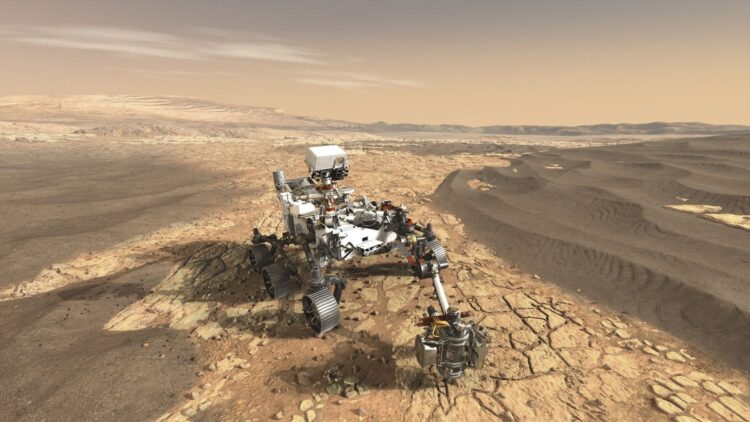
NASA wants to keep exploring Mars with the Perseverance rover, which has been more than 5 years moving around the Red Planet’s surface. During its mission, this small explorer has found many interesting rocks, but its latest finding has surprised scientists: a rock that doesn’t seem to be from Mars. This discovery could help scientists learn more about the Red Planet and meteorites that came from space.
The rock is called Phippsaksla and scientists found it in the Vernodden area of Jezero Crater. Its shape, size, and composition make it very different from the other rocks nearby, and it might be an iron-nickel meteorite that fell from space a long time ago. So, let’s see what this rock means.
What makes the Phippsaksla rock special?
This rock is about 80 cm wide and what makes it so unique is its chemical composition: it contains iron and nickel, which shows it probably didn’t form on Mars. This type of meteorites made of iron and nickel are less common than rock meteorites. They are normally formed in the core of big asteroids when heavy minerals sink in the heart of hot rocks on the first days of the solar system.
What’s more, Phippsaksla has a very different shape and size than nearby rocks. It’s bigger, sits higher, and has a strangely sculpted appearance. This caught the attention of the Perseverance rover, which took several photos of the rock with its Mastcam-Z cameras, both up close and from a distance.
How the Perseverance rover studies the rock
The Perseverance rover has very advanced tools that allow them to analyze rocks from Mars without having to immediately bring them to Earth. To study Phippsaksla, the rover used its SuperCam which has lasers and spectrometers that measure the light reflected by minerals. This allowed scientists to identify the rock’s iron and nickel content.
Also, the Perseverance rover has a built-in drill and a mini laboratory on board. This means it can collect rock samples and analyze them directly on Mars to better understand their origin and history. If NASA decides a sample is valuable, it could eventually be transported back to Earth with another spacecraft, since Perseverance cannot carry it home on its own.
What this finding means
Even though Phippsaksla may come from another place in space, its presence on Mars is not totally unexpected. Other iron and nickel meteorites have been found, but the Perseverance rover hadn’t found one in this area until now. This finding is important because it helps scientists:
- Learn more about the geological history of Mars.
- Study meteorites that came from outer space.
- Compare Martian rocks with rocks on Earth.
Every rock and every meteorite found by the Perseverance rover gives us new clues about how Mars was in the past and about the materials that have come from that planet.
Perseverance rover’s achievements
Since the beginning of its landing in February of 2021, the Perseverance rover has achieved many things. For example, it has:
- Traveled across ancient Martian lake beds.
- Found rocks with surprising features.
- Looked for signs that life may have existed on Mars.
- Taken photos of volcanoes and other landscapes that telescopes on Earth cannot see.
- Set a record for the longest “road trip” on another planet.
And the best thing is that the mission has no end date, so the Perseverance rover will continue exploring and finding new rocks and meteorites in the future.
So…
Thanks to the rover’s advanced instruments, scientists can study these rocks directly on Mars and, if necessary, collect samples for future study on Earth. With each discovery, the Perseverance rover brings us closer to understanding what Mars was like in the past and what mysteries it still holds.