
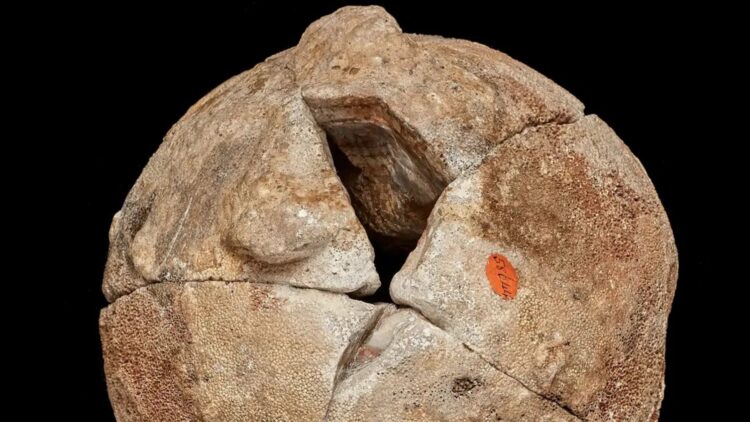
For more than a century, the Natural History Museum in London had on display what everyone believed was an agate stone, huge, giant, pink, white, round… a beautiful stone. But that is it, just an agate.
However, after 175 years in the collection, someone decided to take a closer look at this 15 centimeter stone, because maybe it was not just a decorative rock. Until someone realized that, maybe, it was not just a decorative rock, and that this “stone” was not just a stone, it was a dinosaur egg.
We know it sounds fake, but this egg probably belonged to a titanosaur, a giant herbivore that walked on Earth millions of years ago.
A mystery by pure chance.
In 2018, Robin Hansen, a curator, was preparing an exhibition and was struck by the color and the shape of this stone. He simply liked it, but on a trip in France he saw an agatized egg that looked very similar.
He ran back to London, looked at the piece and thought that something did not make sense, so he called other specialists, they compared shapes, textures and patterns, and everything began to fit, that rough surface, the almost perfect shape, the mineral layers… nothing was random!
They tried to do CT scans to see the interior, but the density of the mineral made it impossible. Even so, the external signs were so clear that it was not necessary to see inside to confirm the suspicion: that was a fossilized egg that had turned into agate.
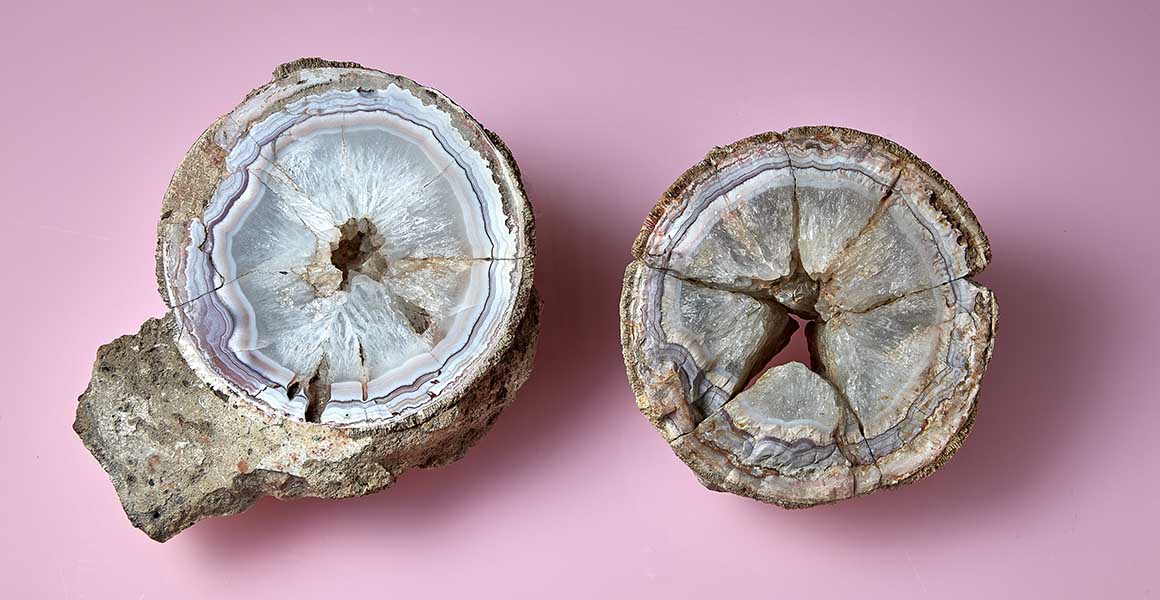
A titanosaur egg
The fossil came from India, exactly where many titanosaurs are estimated to have lived, and besides, its size, the thickness of the shell and the shape matched other eggs found in Asian countries like China.
And the preservation?
When the egg was buried, the volcanic environment of the area allowed water rich in silica to fill the cavity of the egg over time, and that is how the internal crystal bands formed, in which today you can see an agate.
Huge nests… without supervision
Titanosaurs laid between 30 and 40 eggs at once and left them to their fate, there was no maternal heat, nor care, if they survived fine, and if not, there were another 30 eggs more.
Look twice at what we walk past
After being seen by millions of people for almost 200 years, it seems curious that nobody realized that it was not a common agate, and with the knowledge that existed at that time, it is normal that they classified it incorrectly.
But science changes, tools modernize, and suddenly something we believed was a common rock becomes something extraordinary.
The Natural History Museum did not know it had a fossil, and that is incredible!
A rare fossil, beautiful and very lucky
We may never know what was inside that egg because the CT scan did not allow it, but what we do know is that it is a unique piece, half biology, half mineral, that survived millions of years and another 175 passing unnoticed to everyone’s eyes!
And the “common”, with time, can completely change our way of understanding the world. Sometimes it only takes someone to look at us with new eyes 😉