
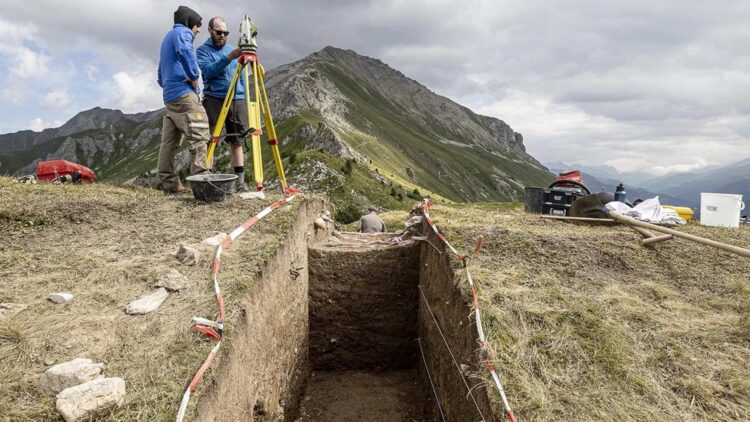
Archaeologists have done it again: A Roman camp has been discovered in the Swiss Alps, at more than 2,000 meters above sea level. This discovery shows that Roman soldiers were capable of operating in the most difficult and extreme terrains, where conditions are harsh and the weather unpredictable. The camp, located in Colm la Runga, changes the way in which we understand the presence of the Roman Empire in mountain areas. So, let’s find out more about this Roman camp.
A military camp over the clouds
The Roman camp is found on a plateau overlooking several important valleys: Landwasser, Albula, Domleschg, and Surses. From this position, the legionaries could monitor movements in natural mountain passes, especially the strategic Lenzerheide Pass. The site includes structures that prove its military function:
- Three defensive ditches
- A perimeter wall
- Internal platforms for soldiers’ activities
These features show the camp wasn’t improvised, but carefully planned to guarantee safety and control over the region.
Historic evidence
The objects found help date the camp in the 1st century B.C., during the conquest campaigns in the Alps promoted by Emperor Augustus around 15 B.C. Among the discoveries:
- Lead sling bullets
- Military shoe nails
- Bullets marked with the Legio III emblem, confirming the presence of this legion in the area
This suggests that the Roman camp may have been a place where soldiers gathered, watched over the area, or rested after fighting near the Crap Ses battlefield. The soldiers who stayed there were trained to move quickly and were able to handle the difficult mountain conditions.
Technology revealed by the Roman camp
This discovery became possible by combining on-site exploration with modern technology. In 2023, a volunteer used LiDAR—an aerial laser scanning tool—to spot shapes and structures that were hidden beneath the vegetation.
Then, in 2024, archaeologists and students from the University of Basel visited the area to study it closely. They carefully mapped the ditches, walls, and inner spaces without digging into the ground. Thanks to this gentle approach, they were able to confirm that the site was truly a Roman military camp.
The strategic importance of the camp
The Roman camp in Colm la Runga shows how Romans controlled key routes in the Alps. Having troops in high positions allowed them to:
- Monitor the movement of goods
- Control enemy troop movements
- Maintain communication between the northern and southern provinces
The location near the Crap Ses battlefield was crucial since it could have been key in the broader military plan, possibly serving as a lookout point or a place for soldiers to organize during their missions.
The Roman camp changes what we knew
Until now, it was thought that Romans only had military presence in the lowland areas of Switzerland, but this finding shows that they also established camps in extreme mountain environments, demonstrating their adaptability, organization, and logistics.
So, archaeologists hope future studies will reveal the following:
- The full extent of the camp.
- The number of soldiers stationed there.
- Connections to other fortified points in the Alps.
Thanks to this Roman camp, we now better understand how Rome controlled the Alps and secured strategic routes, even in the harshest terrains.
To sum up
As technology continues to uncover hidden sites like this, we are reminded that history still has many secrets to reveal. This Roman camp invites us to imagine the soldiers’ daily lives, the challenges they faced, and the ingenuity that allowed them to control some of Europe’s most rugged terrain. It’s a discovery that brings the past vividly to life, connecting us to a world over two thousand years old.
How wonderful is it to learn new things about important events of the past? Sometimes we think that because it’s the past, we already know everything but, as we have seen, that is not true.