
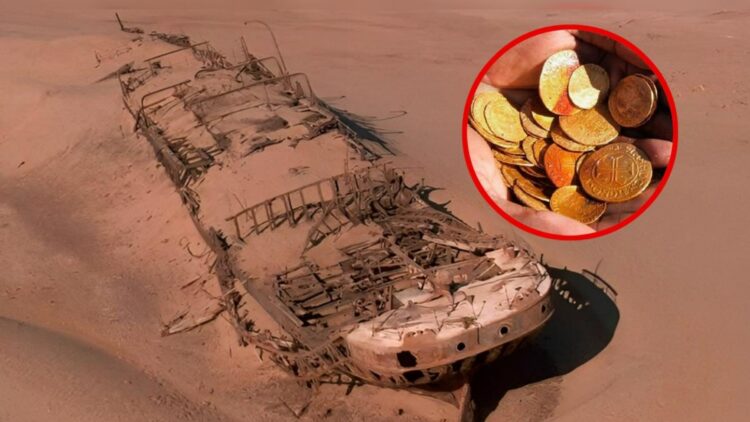
Can you imagine finding a ship full of gold in the middle of a desert? Well, it has happened in Namibia, a 16th century ship full of thousands of gold coins, copper, and ivory that had remained buried in the sand for centuries.
The discovery has been classified as one of the most important archaeological finds of recent years, and it forces us to rewrite the history of navigation and global trade in the middle of the Age of Discovery.
What are we talking about?
The ship in question is the Bom Jesus and it disappeared in 1533. For a long time it was a legend, a sailors’ story, but now history has put it in front of us, with gold, copper, and ivory. The world of that time inside its holds.
Five centuries lost
The Bom Jesus left Lisbon with the objective of reaching India and continuing to expand Portugal’s commercial empire. At that time, the sea was the new battlefield and whoever controlled the routes controlled the world (literally).
But for some reason, the ship’s voyage went wrong. A storm diverted the ship toward the South Atlantic and nothing was ever known again. What was told later were theories, rumors, and fantasies about a vessel full of riches that disappeared without leaving a trace, almost like the Black Pearl from Pirates of the Caribbean.
Beached in… a desert
In 2008, a group of miners was working on the Skeleton Coast (imagine how hostile that place has to be to be called that), but among a lot of sand they found remains of wood and metals, so they continued searching.
What they had in front of them was the tomb of the Bom Jesus, and inside, more than 2,000 Spanish and Portuguese gold coins, copper ingots destined for Asia, and African ivory, the perfect summary of the world of the 16th century.
The Skeleton Coast
This place is not a pirate setting, it is a deadly trap, the currents are treacherous, the fog suffocates… Many ships (and whales) have become stranded there, and finding a lost vessel in that area is not that surprising, but that it has survived intact for so long.
The world from 500 years ago
Looking inside this ship is like looking at a time capsule, European gold, copper in huge quantities, and African ivory, a gigantic, complex, and brutally effective trade network of the time.
Portugal did not just cross oceans to look for spices, it also moved metals, goods, and people in a global economy long before that word existed.
Globalization?
Yes, long before you could order your favorite clothes from Shein, Europe wove its own routes that crossed three continents and thousands of kilometers driven by wealth and ambition.
And once “the Americas were discovered” by the Spanish, the worldwide networks (or the known world) began to be woven and trade became one of the main sources of income, so whoever went farther with their merchandise brought back more money.
Trade as main income
The Bom Jesus is an example of how trade was done at the time, how entire empires were financed, and how risks were taken to find power, European expansion was so great that, although it seems like an epic journey to us, losing a ship at the time was a great economic catastrophe.
Risk, power, and ambition
Spain and Portugal bet their future on conquering all the seas, and each voyage was a roulette wheel. If it went well, they returned with gold, and if not, the water simply swallowed them.
Experts are convinced that there is still much to discover under the sand, objects, documents, clues about who was on board, and perhaps stories of lives that nobody told!