
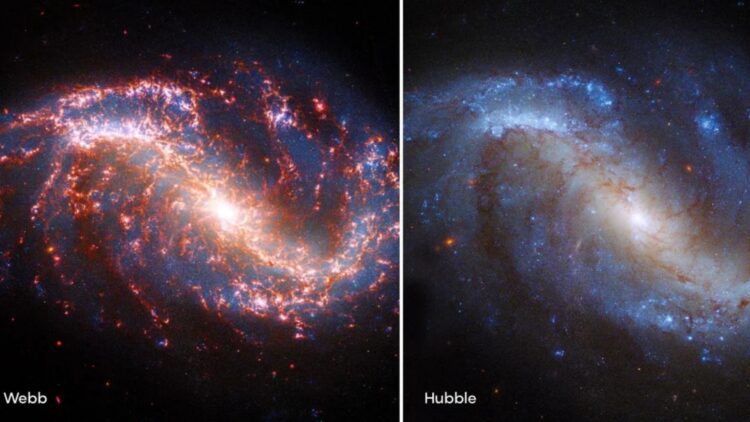
The James Webb Space Telescope has once again made us rethink our history of the universe. It seems, according to what scientists confirm, that the cosmos is not expanding at a single speed (as we have always believed), but that there are two ways to measure it and each one gives a different number. How can that be? Just imagine the scientists taking measurements and seeing that the data in front of them did not match.
These are the data from Webb and from Hubble (the other telescope scientists use), and the famous Hubble Tension is still alive and well, giving us more headaches than ever.
From here, I will tell you calmly how this mess began, why Webb has been key to confirming it, and what it means that modern cosmology is basically in an existential crisis.
Cosmic confusion
For years, scientists have used two different methods. Logic tells us both should give the same number (the Hubble constant), but they do not. Let’s explain what the two methods are and how they differ.
- Method 1: this method analyzes the cosmic microwave background, a “fossil” light that has been traveling through space since the Big Bang. The Planck satellite measured those tiny fluctuations and calculated an expansion of 67 km/s per megaparsec, and this result does fit the standard cosmological model (as it should).
- Method 2: this one uses Cepheids, stars that pulse like cosmic beacons, so scientists measure their brightness and distance to obtain a number. But this number is quite different: 74 km/s per megaparsec.
And that is how cosmology’s biggest headache was born: the Hubble Tension.
Are the measurements wrong?
The curious thing is, no. For years it was believed that Hubble had been confusing Cepheids with other nearby stars, but Webb used infrared to see through dust and chaos and solve the doubt.
1,000 additional Cepheids were examined in five different galaxies, and the result showed that the data Hubble provided was correct and there was no type of error or mix-up.
“If we rule out measurement errors, what remains is the real — and exciting — possibility that we have misunderstood the universe.” Adam Riess
It was not a misunderstanding
Everything is fine, it is not static noise, it is not a mistake, the tension that exists in the universe is real! And although these two methods have clashed, the conclusion scientists draw is that there are still many things we have missed.
What on earth could be happening?
Scientists are considering ideas that sound like science fiction, but are not:
- Dark energy might not be as “constant” as we think.
- The early universe may have played by different rules.
- There could be particles or interactions we do not yet know.
- Or space-time itself may be expanding in ways we still cannot describe.
Is it a crisis?
Now we have to answer that question. Teams will continue investigating using both telescopes and both methods, and they will try to study distances that are even farther away. They are also creating new methods to determine whether something is still slipping away from us. Who knows, this universe is so unpredictable that anything can happen, right?
The only certain thing is that the gap between 67 and 74 km/s/Mpc is not disappearing; it is becoming even more evident. And we do not want to get too excited… but maybe we are close to a new scientific revolution!