
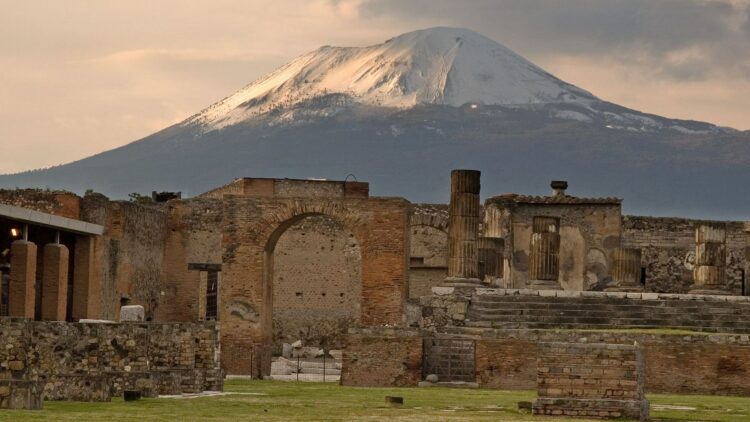
For centuries, Roman concrete has fascinated the entire world. You only have to look at aqueducts, temples, and all the walls of what they built still standing almost two thousand years later, while many modern buildings begin to crack in just a few decades. Something did not add up for architects and archaeologists, and now, after deeper research in Pompeii, it seems we finally have a very clear answer.
Pompeii disappeared after the eruption of Vesuvius in 79 AD, and as you know, it was frozen in time. Thanks to that, archaeologists have been able to look into the workshop of a Roman builder who was buried under the ashes in the middle of a workday. So, for better or worse, thanks to this worker we now know how they made the concrete that has lasted so long.
A renovation left unfinished
The key was a house under renovation. When the volcano erupted, that home was being remodeled, and what was left under the ash was a three dimensional Roman construction manual. There were half built walls, abandoned tools, piles of unused materials.
Of course, for researchers this is a tragedy, but it is also an incredible way to study what the process was like. Otherwise, the doubt would still remain.
Simple ingredients
Inside the room, clear accumulations of lime, volcanic ash, fragments of broken ceramics, and stone were found. There was nothing strange, but what was interesting was how they mixed it all, something that had gone unnoticed for years.
The famous “hot mixing”
For a long time, it was believed that the Romans used slaked lime, as is done today. But chemical analyses showed that they used quicklime directly, causing an intense reaction when mixed with the rest of the materials. That reaction released a lot of heat and created an internal structure completely different from modern cement. More porous, more flexible, and with a trick.
Self healing concrete
That mixture left small undissolved fragments of lime inside the concrete. Over time, when water seeped through inevitable microcracks, those fragments reacted and sealed the fissures from the inside. It not only resisted better, it repaired itself, as if it had a built in maintenance system.
The older, the stronger
Microscopic studies confirmed that over the years this concrete forms new minerals that reinforce its structure. Exactly the opposite of what happens with many modern materials, which degrade over time. In the walls of Pompeii, ancient repairs made with the same method have even been identified. It is clear that this was not a one time thing, it was the way construction was done in Ancient Rome.
Beyond what Vitruvius wrote
The famous Roman architect Vitruvius left written recipes, but this discovery shows that practice was ahead of books. The Romans experimented, adjusted, and improved on the fly, and that is why their constructions are still intact. Pure empiricism and efficiency.
And what is this useful for?
The cement industry is responsible for a huge share of global CO₂ emissions, in addition to the constant maintenance required for bridges, roads, and buildings. If materials inspired by this concrete begin to be developed, which is self repairing, it would mean fewer repairs, much less environmental impact, lower costs, and a much smarter approach overall.
Archaeology of the past for the future
Under a layer of ash, in an ordinary house, the Romans preserved knowledge that today is more relevant and necessary than ever. Sometimes, to move forward, you have to look to the past.