
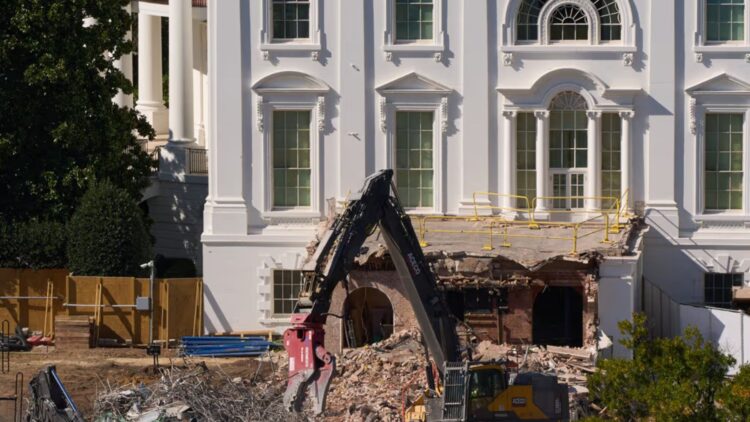
The White House is not just the Oval Office, and with the number of hours our leaders spend there, how could they not want to build a ballroom. We are not joking, it sounds like it is, but it is not. The government is building a ballroom inside the presidential complex and it has already caused a clash between the Government, the Justice system and defenders of historic heritage.
A what?
A ballroom. And they are classifying it as national security (we swear this is true). Now the Trump administration has taken the matter to a federal court under that same pretext, and they also claim that stopping the construction would put the protection of the president at risk.
National security?
In a 36 page court document, the White House argues that stopping the construction, even temporarily, would make the work of the Secret Service more difficult. In fact, the deputy director of the agency says that the affected area still needs more interventions to meet security standards. But there are no details. The government has limited itself to saying that the information is sensitive and that it would only explain it to the judge, in private, behind closed doors and without the plaintiffs present. Wow.
Of course, the lack of public explanations is exactly what has fueled criticism, both on social media and in political life. For those who oppose the project, invoking national security without giving even a hint sounds more like using a wildcard than a solid justification.
The official response, however, is that the risk exists, even if it cannot be detailed, and that any delay could compromise presidential protection.
And who wants to stop the construction?
The lawsuit was filed by the National Trust for Historic Preservation, an organization dedicated to protecting historic buildings. They want independent reviews to be carried out, a public consultation period to be opened and Congress to give its approval to the project. According to this group, no president can demolish parts of the White House or build structures on public land without following the procedures set out by federal law.
Presidential power vs. heritage protection
For the plaintiffs, allowing the project to move forward without external controls would set an extremely dangerous precedent. The administration responds that the White House has changed many times over more than 200 years and that the president does have the authority to modify it when he considers it necessary.
But to build a ballroom?
It is a hall of about 90,000 square meters, with capacity for around 1,000 people and an estimated cost of 300 million dollars, financed with private funds. According to Trump, it is to avoid temporary tents at official events, but to do that they have to demolish the East Wing of the White House, built over an old emergency bunker.
It is not fully defined yet
Although preparatory works are already underway, the final design is not yet closed, and construction would not begin until April 2026.
The Department of Justice states that the damage claimed by the plaintiffs can no longer be reversed, at least with regard to the initial demolition, and argues that there is no immediate and irreparable harm, since the bulk of the construction will take months to begin.
Criticism
Architects, heritage experts and political figures have questioned both the size of the ballroom and the speed with which it was internally approved. For many, this case reflects a way of governing that prioritizes rapid executive decision making over dialogue and public participation.
It could shape the future
How far can a president go in modifying a building that is a national symbol? The White House is not just an official residence. It is history, representation and collective memory.