
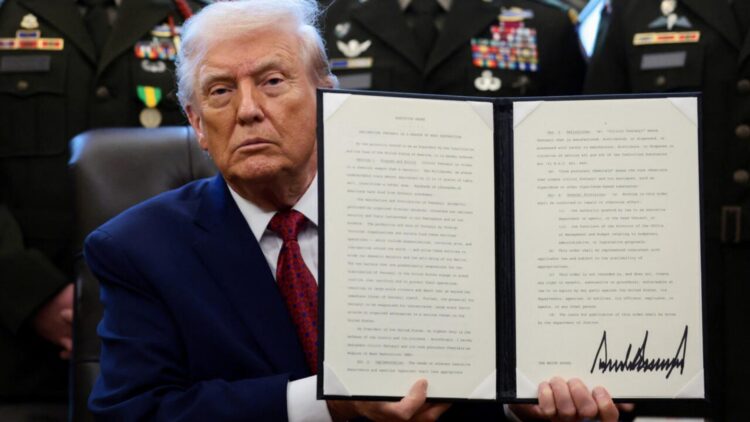
Drugs are a problem, a big one. Always have been, and always will be. In recent years we have seen how a new synthetic drug has begun to dominate our neighborhoods and many of our neighbors: fentanyl. You have probably seen videos of addicted people, and it is very frightening. Trump wants to put an end to this and has stated that he has signed an executive order under which fentanyl is now considered a weapon of mass destruction, arguing that it resembles a chemical weapon more than a narcotic.
This measure represents a sharp shift in United States anti-drug policy and reinforces a much tougher and more militarized approach against the cartels that are spreading this drug.
“Weapon of mass destruction”
Fentanyl is an extremely powerful synthetic opioid that is used in medicine to treat very intense pain, just like morphine. The problem is not its controlled medical use, obviously, but its illegal version, manufactured and produced without supervision, which is up to 50 times more potent than heroin and has become the leading cause of overdose deaths in the United States.
By labeling it a weapon of mass destruction, the White House will be able to operate with broader authority to pursue those who produce and distribute this drug. Under the US legal framework, weapons of mass destruction include nuclear, chemical, biological, or radiological weapons.
A change in language and mindset
Calling a drug a “weapon” is not accidental, especially given the news we have been seeing lately. Drug trafficking is no longer framed as a public health issue, but as a national security threat, and this shift in focus will justify much more aggressive operations, even outside US territory.
The figures Trump uses to raise the alarm
During his speech, Trump spoke of between 200,000 and 300,000 annual deaths linked to fentanyl. It is clearly a public health problem.
Fentanyl as a covert chemical weapon?
Many public health and addiction experts point out that fentanyl is not deliberately used as a weapon. Its lethality is the result of a poorly managed opioid crisis and an unregulated illegal market, and the problem is clearly health-related, social, and structural, not military.
The risk of oversimplifying a problem
Many believe that militarizing the discourse can overshadow key policies such as prevention, addiction treatment, or harm reduction, precisely the tools that save the most lives.
Since September, the United States has carried out more than 20 operations in the Caribbean against suspected drug trafficking networks, and missions focused on combating narco-terrorism in the Western Hemisphere have already been announced.
Cartels, increasingly close to terrorism
At the beginning of his second term, Trump had already designated cartels as foreign terrorist organizations, and of course they do not want to act against them, always within their own territory, because there is never a problem there.
International tensions
The issue is that this warlike language does not stay at home, and neighboring countries are already seeing how the US operates very close to their borders, opening yet another debate: the sovereignty of neighboring communities.
So we will have to wait and see what happens and how it is applied.
A precedent that could mark an era
Classifying a drug as a weapon of mass destruction has no clear precedent in modern anti-drug policy, but it is clear that the legal and political framework has changed and that the government is willing to go much further. Will this reduce deaths, or is it just an excuse to target other countries?