
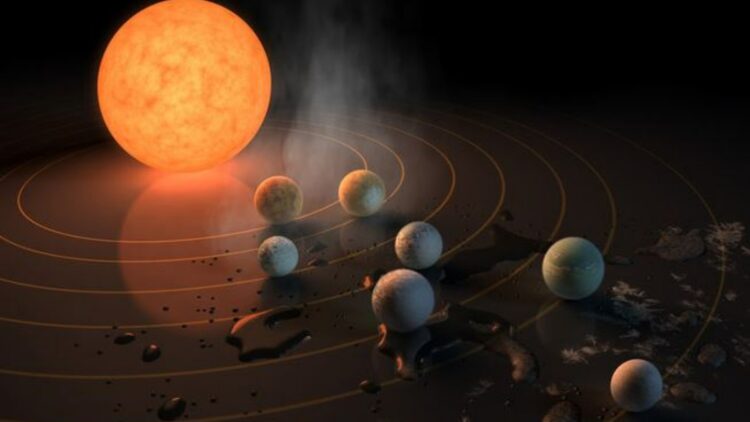
TRAPPIST-1 was our hope, seven rocky planets, sizes similar to Earth, several in the famous “habitable zone” and, on top of that, only 40 light years away… basically the full package for there to be life out there. It was the system everyone thought of when thinking about life beyond the Sun. But science has moved on and it is time to lower the hype a couple of notches.
The latest observations from the James Webb Space Telescope have provided new data that have left us stunned. Most of the TRAPPIST-1 planets do not have an atmosphere, or at least none can be detected because they are too weak and thin. That means it would be difficult for there to be life, as we know it, on any of these planets.
The system that made astronomy fall in love
Between 2015 and 2017, TRAPPIST-1 went from being a modest star to the object of all our astronomical desires. Seven rocky planets orbiting an ultracool dwarf star. Three of them were placed exactly where calculations suggested liquid water could exist. It was the place, the star candidate for finding life, humanoid or not.
Compared to our Sun, TRAPPIST-1 was small and cool, but it allowed the closest planets to maintain much more reasonable temperatures. A perfect orbit was not required, just a good greenhouse effect and an atmosphere, of course.
James Webb broke the spell
That is what it is there for, to help us discover the galaxy. But when observations of this star began, many expected water vapor, gases, or signs of atmospheres. For the inner planets, TRAPPIST-1b, c, and d, the conclusion was that there are no atmospheres that would allow life. Either they were lost long ago, or the models were wrong, or they simply never existed.
Without an atmosphere, there is no life
We know only one type of life, Earth life, and we exist thanks to an atmosphere that protects us, regulates temperatures, and allows complex chemistry to form life. Based on these premises, it is impossible for there to be life in this system.
A star that is too violent
Perhaps everything is due to the fact that TRAPPIST-1 is not a particularly calm star. It emits flares, has very intense radiation, and releases energetic particles throughout the system. If these planets do not have an atmosphere to protect them or a sufficiently strong magnetic field, they remain permanently exposed.
From excitement to realism
For years, some models suggested that even thin atmospheres could survive, that perhaps the system had mechanisms we did not fully understand. But Webb does not disappoint or fail. Many of those signals did not even come from the planets, but from the star itself.
So does TRAPPIST-1 no longer matter?
It is not that it does not matter. The outer planets, TRAPPIST-1e, f, and g, are still being studied, especially TRAPPIST-1e. There could still be some hope there, but we do not want to get our hopes up too much.
TRAPPIST-1e: the last hope
Some data point to possible signals compatible with gases such as nitrogen or methane, but nothing is conclusive at the moment. Still, it is enough for scientists to want to continue investigating, just with much more caution.
How it will really be confirmed
They will observe several planets at the same time, allowing them to identify what belongs to the star and what belongs to a planet with a possible atmosphere. Only if TRAPPIST-1e proves to have a stable atmosphere will the debate resume.
To search for life beyond
A planet needs more than rocks and proximity to its star. We know that life on Earth cannot be the only one in such an immense galaxy, but the balance between atmosphere, radiation, magnetic field, and time must be found.
Who knows, even if there is no longer a favorite, the universe is still waiting for us. We are getting closer and closer.