
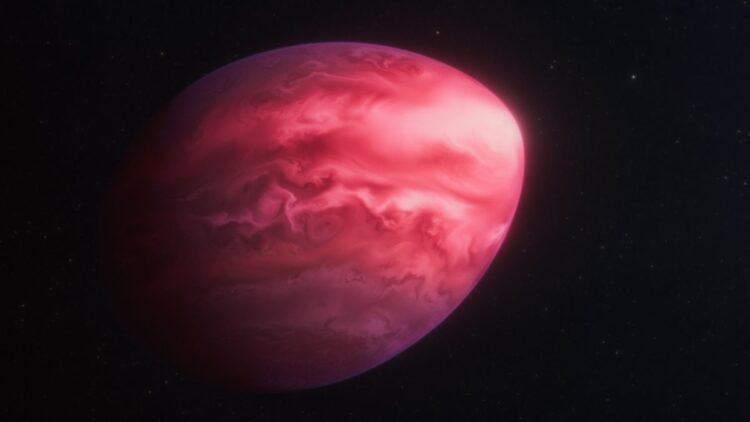
When we think we have already seen everything in the universe, a very strange planet has just appeared, shaped like a lemon. An exoplanet so rare and so far from everything we know that even the scientific world did not expect it. It is called PSR J2322-2650b and it looks like nothing we have seen before.
The discovery has been confirmed, obviously, by NASA’s James Webb Telescope, the most advanced telescope to date, and now researchers want to understand how planets are shaped and deformed and, above all, why this happens.
A lemon with an orbit
This planet is literally stretched by gravity and orbits dangerously close to a pulsar, a very dense neutron star with enormous gravity. Because of this, there are extreme tidal forces that deform it, as if we were squeezing a balloon over and over again before it bursts. It is not a perfect sphere, Earth is not either, but it is an elongated and very strange world to look at.
And the temperatures?
As if the shape were not enough, temperatures are around 1,900 degrees Kelvin. Very hot. A constant inferno. But the most puzzling thing is not the heat, it is what floats up there, because there is no water vapor or carbon dioxide. Instead, molecular carbon dominates in forms never seen before. A very strange chemistry that has made scientists think we are facing a completely new type of atmosphere.
Do the winds blow backwards?
The most curious thing is that the atmosphere rotates in the opposite direction to the planet, as if the air had a will of its own. These are supersonic winds, driven by the brutal radiation of the pulsar. On this planet, the classic rules we know on Earth do not exist.
What if it is not a planet?
Some scientists believe that PSR J2322-2650b may not have been born as a planet, but as a small star or dwarf that the pulsar gradually stripped of its layers until only the core remained. That would explain its shape and its helium and carbon composition.
And attention, because scientists believe that in this “planet” diamonds could rain in its deeper layers. Can you imagine that?
It is not a gas giant, not a rocky planet, not a dwarf star. So what is it? For now, we do not know. This object blurs the line between planets and stars and forces us to rethink concepts we thought were settled. How incredible our galaxy is, surprising us with something new every day.
The role of the James Webb
Of course, none of this would have been possible without the infrared eye of the James Webb. Its ability to see where other telescopes cannot made it possible to isolate the planet’s signal despite the extreme radiation of the pulsar. Webb allows us to study much more extreme worlds and discover what else is hiding out there.
The questions
Scientists still have many questions about PSR J2322-2650b. How does it keep its atmosphere without losing it? Why are some key elements missing? How many planets like this might be hidden, waiting to be discovered?
A lemon shaped planet, a carbon atmosphere and winds that blow the wrong way. A few years ago, no one would have even imagined something like this. And maybe that is the most beautiful part of all. Knowing that even as we get closer to understanding the galaxy, it always has something new to tell us and leave us amazed.