
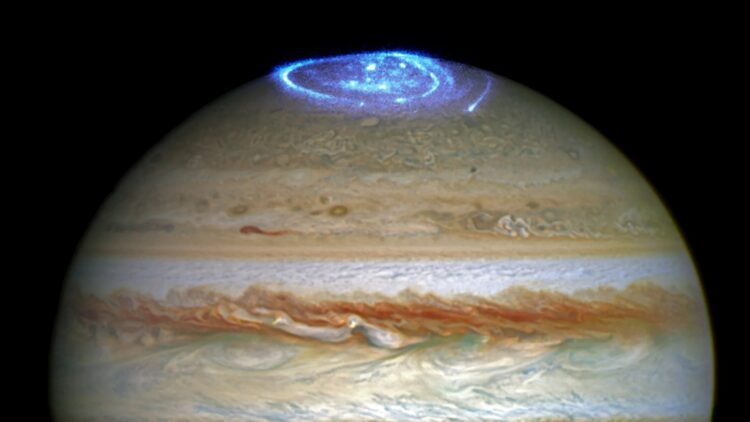
Jupiter’s blue aurora was not in any scientist’s plans. It is not only beautiful, it is rare, enormous, and unexpected. And no, nobody saw it coming. NASA researchers have discovered that at the poles of the giant planet there is a bluish luminous crown so powerful that it has no comparison anywhere in the solar system. Nothing like it had ever been seen before, not in size, not in energy, and not in behavior. It is a stable and very wild phenomenon. We explain how auroras work on Jupiter.
Something strange was happening on Jupiter
For years, astronomers suspected that Jupiter’s poles were hiding something special, mainly because its magnetic field is the strongest of all the planets and can channel any particle. But nobody expected its crown to be covered by a bright blue mantle, as if it were wearing a giant energetic halo.
The first clues arrived in the year 2000, thanks to the Hubble Space Telescope, but there was still much more to see.
Two telescopes, one surprise
The big leap came when Hubble began working hand in hand with the James Webb Space Telescope, which as you know is the most advanced one we have.
When they work separately they are good, but when they work together they are incredible. They detected pulsations, energy discharges, and an intensity never seen before in an aurora. These auroras do not behave like those on Earth. On Jupiter, energy seems to explode in bursts, as if the planet were constantly releasing tension.
Io, the moon that revealed everything
And this is where Io comes into play, a moon of Jupiter that has been studied for years. This moon is the most volcanic place in the solar system. It constantly ejects material into space, which gets trapped by Jupiter’s magnetic field and is driven toward the poles. That is when this stunning ultraviolet blue appears, when it impacts the planet’s atmosphere.
An aurora that is alive
Another detail scientists have confirmed is that this is not a static process. The aurora goes through phases, it changes, pulses, intensifies, and fades within minutes. Jupiter has become a favorite object of study for scientists to understand how magnetic fields work when taken to the extreme.
Why is it important?
Because it is something we did not know. In addition to being the largest and most energetic aurora in the solar system, if Earth’s auroras already fascinate us, imagine one this large, this energetic, and pure blue.
It breaks the rules of everything we know, and it helps us understand how distant planets and exoplanets might work. Or maybe we need to create a new term for planets where the energy looks more like that of a star than that of a planet, do you not think? There is still so much left to discover.
And now what?
Now it’s time to keep studying. NASA wants to observe the aurora in real time, see whether it evolves, and understand how it interacts with Jupiter’s other moons. What once seemed like a glow without a purpose is now known to be one of the most extreme and fascinating phenomena ever observed by humankind.