
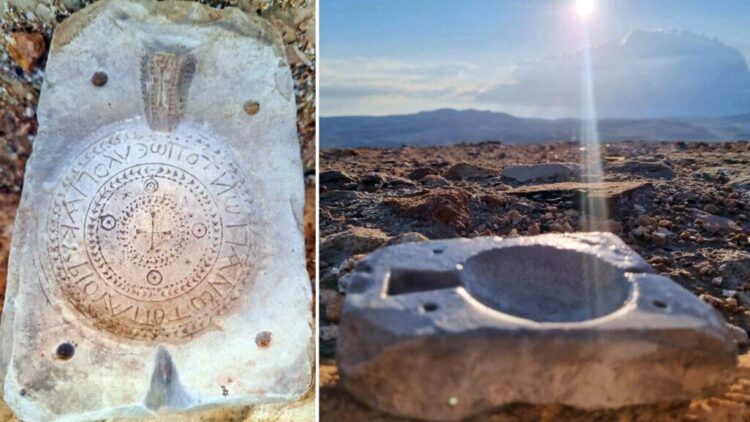
In the middle of the Judean Desert, archaeologists have found a mold that is helping experts better understand how early Christians practiced their faith and how the first religious tourism worked. This discovery is incredible because it’s a 1,400-year-old mold that was used for creating sacred souvenirs for pilgrims. So if you’re curious about this object and the story behind it, don’t worry—we’ve got you covered. We’re here to walk you through everything in a super easy way.
The mold
What archaeologists found was a two-part limestone mold that was created to make ampullae, which are small bottles pilgrims took home. They normally contained oil, water, or soil from holy places.
The mold has a cross on it and a Greek phrase that basically says, “a blessing from the holy places.” In other words, this little gadget was used to make religious souvenirs for Christian visitors—kind of like the ancient version of a gift shop item!
This object was found in Hyrcania, an ancient monastery built on top of an old fortress. The monastery was in an isolated place, but at the same time it was an important stop for pilgrims who traveled through the Holy Land during the 6th and 7th centuries.
‘’Sacred souvenirs’’ for pilgrims
During these centuries, the Holy Land became one of the main destinations for Christians of the Byzantine Empire. Thousands of people traveled every year to places like Jerusalem, Bethlehem, the Mount of Temptation, or the Monastery of Mar Saba. They looked for forgiveness, miracles, or simply a deeper connection to their faith.
Monasteries like Hyrcania weren’t just quiet homes for monks—think of them as the “rest stops” of ancient spiritual road trips. Pilgrims could pause there to eat, rest, stay safe, and yes… pick up sacred souvenirs to show they’d visited holy places. One of the most popular souvenirs was a tiny ampulla, a small container that let travelers carry blessings back home to places as far away as Italy, Greece, Asia Minor, and even North Africa.
Hyrcania
The monastery of Hyrcania was not always a Christian religious center, before that:
- It was a Jewish fortress built in the 2nd century.
- Then, it was rebuilt by Herod the Great as part of his defense system.
- With the passage of time, it was abandoned.
- Finally, in the 5th century, it turned into a Christian monastery, guided by the ideas of Saint Sabas.
The location was not randomly chosen, the Judean Desert was considered a perfect spot for praying and spirituality. At the same time, it was near the routes connecting Jerusalem with other cities. This made it convenient for passing pilgrims.
Recent digs at the site turned up all kinds of cool stuff from the 6th and 7th centuries: gold coins, a ring made of yellow stone, and Greek writings. All these discoveries tell us one thing: Hyrcania wasn’t some quiet, empty spot. It was a lively monastery that welcomed visitors—and maybe even some female pilgrims, which wasn’t common back then, but definitely could have happened.
A small object with a significant meaning
The ampullae created with this mold were designed for a specific task: containers of the sacred. They were not just simple tourist souvenirs, they were religious objects people carried with them to preserve the Holy Land’s blessing.
Finding this mold in its original place is particularly important because it allows experts to understand how the production of these objects worked: right there at the monastery.
Also, it helps explain why similar ampullae have appeared in such faraway cathedrals like the Monza Cathedral in northern Italy.
So, you can see that such an object (apparently) as insignificant as a mold, can tell us so much about a specific time in the past. Isn’t it incredible?