
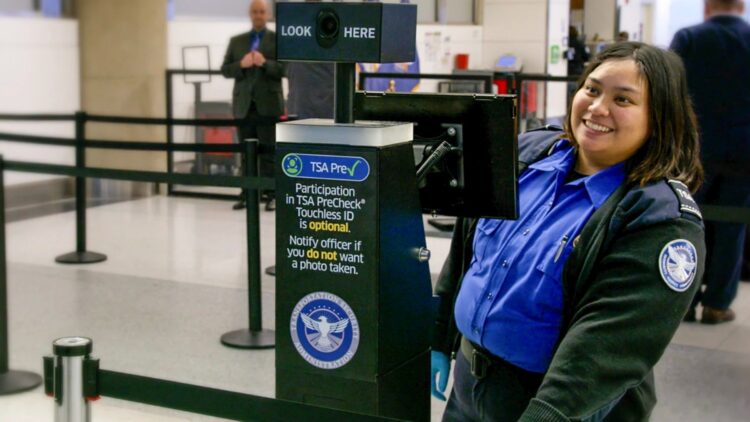
Traveling around the country is going to change in 2026 because the TSA has confirmed that they will expand a new system for travelers. They say it is faster and safer, but the novelty is that you will not need to go through security showing your physical ID document (what?!).
That is right, 2026 will be the year when saying “cheese” becomes the new normal at airport checkpoints. You will be able to board a plane using facial recognition based technology. At first, only 50 airports will implement this proposal, and they promise fewer lines, less stress, and a much faster security process. Will it really be like that, or will we be giving away our biometric scan just to save a few seconds?
New changes at the TSA
As you already know, they have been testing technological improvements for months, but until now everything had been limited to a very small number of airports and travelers. Starting in spring, this will become the norm at 50 airports. It is called PreCheck Touchless ID and it has arrived, according to them, to stay.
The difference? If you are an eligible passenger, you will no longer have to show any document. You will stand in front of a camera, the system will verify your identity in seconds, and you will be able to continue without showing any paperwork.
How does it work exactly?
The system will compare your face, captured at the airport, with your official images, the one on your passport or visa. If the biometric scanner matches, you can pass without problems. All of this is done within a secure database, according to the TSA.
It is important to note that there is a prior step: you must register through your airline. Once that is done, the process is ready, and with scanners there is no need for paper documents.
From a few airports to almost the whole country
Until now, this system was only available at around 15 airports. In 2026, the number will increase to 65, with 50 new additions.
Priority is given to high traffic destinations. Airports like Miami, Orlando, Boston, Dallas, or San Francisco are among the first on the list.
More speed
From an operational point of view, the advance is huge, that cannot be denied. Fewer lines, fewer human errors, and more time for agents to focus on what really matters are expected.
But not everyone is happy with this change. The use of biometric scanners and the registration of our facial data makes many people uneasy. The TSA insists that everything will be managed with very strict protocols, but knowing that there are many hackers out there, it is normal that many people doubt the security behind this system.
What do experts say
Some try to downplay the issue because these are data that the government has had for many years, so the system would not be adding any new type of risk, only speeding up the process.
But others warn that normalizing facial recognition in public spaces can set a dangerous precedent and that limits should be placed on this type of technology.
And you, as a passenger, what do you need to know?
For most travelers, the change will be almost imperceptible. Maybe shorter waits, fewer nerves, and a much smoother security process, especially during peak hours.
The important thing to remember is that for now, it will not be mandatory. If you prefer to keep showing your documents as always, you will be able to do so, because it is your right. Biometrics may be the future, but if you do not want to say “cheese” to the TSA agent, you are fully entitled to that.