
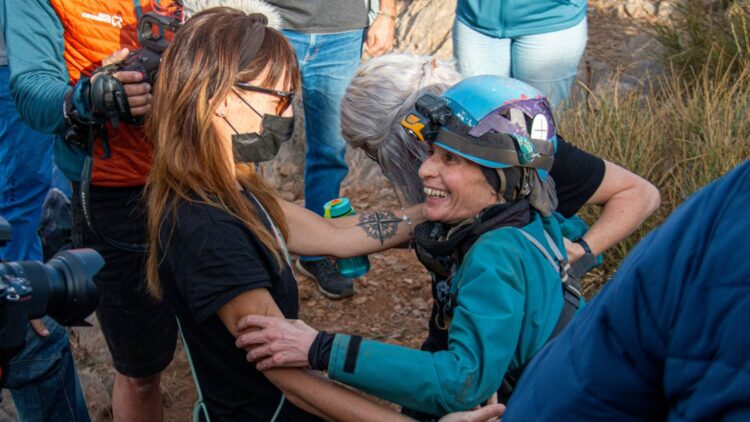
One woman, one cave, and 500 days of absolute solitude. Just like that, this is the story of Beatriz Flamini, a Spanish mountaineer whose story has gone around the world. About 70 meters underground, in a cave in Granada, Spain, she lived isolated from time, from news, and from any human contact. When she came out, she smiled and asked what day it was. She left the cave smiling and surprised that time had passed so quickly because, according to her, she had not had time to finish the book she was writing.
Was it an experiment?
Everything began on November 20, 2021 and ended in April 2023. Five hundred days. Without a clock, without natural light, without any reference to what was happening outside, and outside many things happened… But she had a mission, to endure underground and not lose herself.
You might be surprised to learn that she did not do it to break any record, but to understand what happens to our brain when loneliness lasts so long that time stops making sense. Psychologists, neuroscientists, and cave experts followed the experiment remotely, but without speaking to her. Zero human contact.
What was the experience like?
After 500 days in a cave, Flamini explained that around day 65 she lost track of time, even though she had tried to count the days. Her team revealed that the mountaineer had to leave the cave for 8 days, although she remained isolated in a tent, because the router that allowed her to send audios and videos broke, even though she did not receive any response because she was isolated.
When she came out, she thought much less time had passed. For the researchers, this confirms that time is not just a matter of clocks and routines. Once those disappear, time disappears as well.
What is it like to live underground?
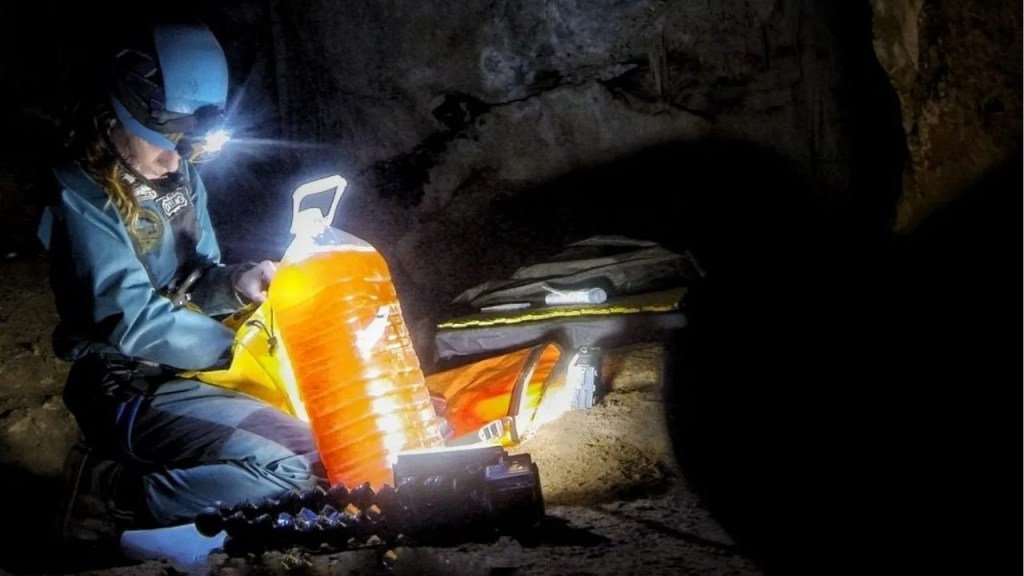
Inside the cave, Beatriz organized herself as best she could. She read, wrote, painted, exercised, and recorded videos to document the experience. She read more than 60 books, drank close to 1,000 liters of water, and followed a controlled diet that her team delivered without seeing her.
The silence was total. She did not even speak out loud, but she did speak to herself through internal dialogue. Something key to not going crazy and to stay strong if she weakened.
Were there hard moments?
Obviously, 500 days without human contact meant there were more difficult days than others. The mountaineer explains that she suffered an invasion of insects inside the cave that tested her patience and her mood. But she was clear that she did not want to give up.
She accepted one of the harshest rules of the experiment, and that was that her team could not tell her if any family tragedy occurred. Quite cruel, but no one wanted to alter the process.
Record or lesson?
Although there is no official category for something like this, many experts agree that no one had spent so much time alone in a cave, in a conscious and planned way.
But the value lies in what was learned and in what it can contribute to studies on space missions, confinement, or extreme situations.
What happened when she left the cave?
When she came out, Beatriz asked for a shower, food, and to see friends. Then came medical tests, interviews, and the rest of the world.
Her story shows that the human mind can adapt to almost anything, but that time is a purely human construct. Five hundred days alone underground to understand that sometimes, the greatest challenge is not the darkness, but being alone with oneself.