
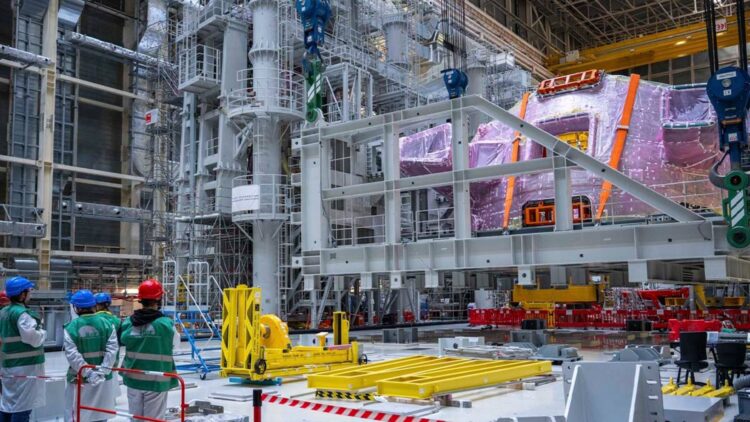
Today, we are going to talk about one of the most ambitious constructions in history: ITER. This international project’s goal is to recreate the same energy the Sun produces, but on Earth. It’s basically a giant project that wants to prove that nuclear fusion (a way to generate clean and very powerful energy) could be the solution for the future of the planet. So, let’s learn more about this incredible construction.
The epic construction
ITER is located in Cadarache, in the south of France. This is not a plant producing energy for cities, but a huge lab designed for recreating the process happening inside the Sun. This process is nuclear fusion, which releases great amounts of energy when very light atoms stick together.
The project has taken more than 20 years of planning, testing, and teamwork between many countries. Now, ITER has reached one of its most important and delicate moments: starting the final assembly of the vacuum chamber. This is the huge container where the plasma will be made and controlled. Plasma is a very hot type of matter that will reach 150 million degrees Celsius — far hotter than the center of the Sun.
The central chamber of the reactor, known as the vacuum vessel, is made of nine enormous steel sections built with millimeter-level precision. Each section weighs dozens of tons, and together they weigh more than 400 tons. This makes ITER one of the heaviest and most precise scientific structures ever made.
How the reactor works
ITER’s goal is to prove that nuclear fusion is possible at large scale. The idea is to achieve light hydrogen atoms to stick together and release energy, as the Sun does. To avoid the plasma destroying the reactor due to its hot temperature, they will use powerful magnetic fields that will keep the plasma floating without touching any solid surface.
Why nuclear fusion? Well, it has several advantages:
- No long-lasting radioactive waste.
- Zero carbon emissions.
- A nearly unlimited fuel source.
- A lower risk of catastrophic accidents.
Engineering pushed to the absolute limit
To control the plasma at extreme temperatures, this construction needs a lot of systems to work together perfectly. So, it will be used:
- Automatic shutdown protocols for any anomaly.
- Giant superconducting magnets.
- Redundant safety and containment systems.
- Real-time thermal and magnetic sensors.
The most difficult part will be to keep the plasma stable for a long time, which has only been achieved for short moments in much smaller experimental reactors. If ITER can control plasma successfully, it would prove that fusion could work on a much larger scale.
A construction that redefines engineering
It’s obvious that ITER is completely different from any construction ever done before. It requires extremely precise work, giant pieces of equipment, advanced technology, and teamwork from countries all over the world. Everything has to be done perfectly, because even a very small mistake could affect how the reactor works.
Although ITER will not produce electricity for the grid, its mission is even more important: to prove that nuclear fusion can work on Earth. If it succeeds, it will open the door to a new generation of fusion reactors, which could operate for decades or even centuries, providing clean and powerful energy. This would completely change the way future energy systems are designed and built.
So…
Can you imagine the impact this construction could have on energy production? We’ll see if everything goes as planned, but just to read how the whole process of making ITER works gives us hope for the future of engineering.