
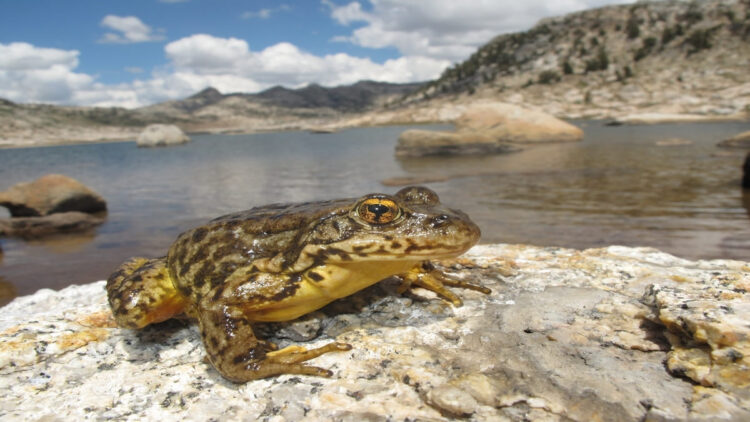
After decades of silence in the high mountain lakes of the Sierra Nevada, the song of the yellow-legged frog (Rana sierrae) can once again be heard, marking a historic milestone in species conservation. This amphibian, once abundant in the region, suffered a catastrophic collapse due to the combination of two threats: a deadly fungal disease known as chitridiomycosis and the introduction of non-native fish.
Now, after years of scientific and conservation efforts, they have been successfully reintroduced, not only revitalizing local ecosystems, but offering hope for endangered species around the world.
The gold seekers who came to California in the 19th century left their mark not only on the rivers and mountains, but also on the fragile alpine ecosystems. As they explored the Sierra Nevada, they began introducing non-native fish into previously fishless lakes. This practice, intended to provide food and recreation, became a direct threat to the yellow-legged frog that inhabited these waters. The invasive fish consumed the frogs’ eggs and tadpoles, decimating their populations.
Adding to this threat was the emergence of a devastating pathogen at the end of the 20th century: Batrachochytrium dendrobatidis (Bd), responsible for chitridiomycosis. This fungus infects the skin of amphibians and disrupts vital functions such as respiration and water regulation. Within a few decades, Bd brought the yellow-footed frog to the brink of extinction, eliminating it from more than 90% of its historic range.
“The loss of this species was not only a blow to biodiversity, but to the entire ecosystem,” said Roland Knapp, senior scientist at the Sierra Nevada Aquatic Research Laboratory at the University of California, Santa Barbara (UCSB). Predators that depended on these frogs, such as birds, snakes and bears, saw their diets disrupted, and aquatic ecosystems were drastically altered.
An Innovative Survival Strategy
Despite this bleak outlook, a team led by Knapp refused to give up. For nearly three decades, the researchers searched for remnants of frog populations in fishless lakes and began documenting cases in which some individuals showed resistance to the Bd fungus. These discoveries marked the beginning of an ambitious reintroduction project.
The study, published in the journal Nature Communications, details how the researchers identified 12 lakes suitable for reintroduction, taking into account factors such as altitude, winter severity and the absence of predators. They then translocated Bd-resistant frogs to these sites and monitored their adaptation for 17 years.
“The planning was meticulous. Each site was carefully evaluated to maximize the chances of success,” Knapp said. The results were surprising: the translocated populations not only survived, but began to reproduce. Today, it is common to see hundreds of tadpoles and dozens of adult frogs in the reintroduced lakes. “The lakes have come back to life,” Knapp said. To see frogs sitting on the bank surrounded by birds and snakes interacting with them is something we never expected to see again,” he told USA Today.
Global Impact and Lessons Learned
The success of the Yosemite project has implications beyond the Sierra Nevada. According to the authors of the study, this experience provides a replicable model for the conservation of other disease-threatened species.
“The case of the yellow-legged frog shows that with resistant individuals and strategic planning, it is possible to reverse the devastating effects of pathogens on ecosystems,” Knapp said. This approach may be particularly relevant for other amphibian species, a group facing a global crisis with more than 40% of its species threatened with extinction.
The project also highlights the importance of protected areas such as Yosemite for biodiversity conservation. “National parks and reserves not only conserve landscapes, they are also critical refuges for endangered species,” the research team said.
The positive effects are not limited to tree frogs. The recovery of these populations has restored important ecological dynamics, such as predator-prey interactions. In the reintroduced lakes, birds like the Clark’s nutcracker and the gray-crowned rosy finch have returned to feed on tadpoles, while species like the water snake are once again dependent on tree frogs for food.
Despite these successes, challenges remain. Climate change and human threats continue to threaten mountain habitats. But researchers are optimistic. Viability models suggest that reintroduced populations have a high probability of persisting for at least 50 years, as long as conservation efforts are maintained.
“Fifteen years ago, we weren’t sure if this species would survive,” Knapp reflected. “Today, they are not only surviving, but thriving. That gives us hope for many other species in similar situations.”