
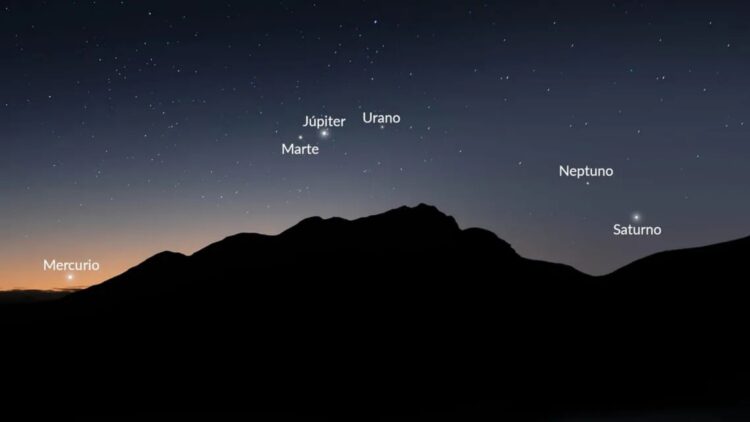
The sky is going to be dressed up to say goodbye to the month of February! We are going to be able to see an incredible planetary spectacle that will not be repeated for several centuries. The seven planets of the Solar System will align in the sky and will be visible at the same time! A real spectacle for those of us who love looking at the sky and seeing the stars.
From February 25th to 28th, the night sky will be practically magical with this unique opportunity to be able to observe the firmament dressed up in gala attire.
The best and most exciting thing of all is that you can see it with the naked eye, so you don’t need a telescope to enjoy it. Some planets will be so bright that they can be seen with the naked eye, while others, like Saturn and Mercury, will glow faintly in the night sky. Visibility will be impressive these nights, especially on February 27, when there will be a New Moon and the sky will be much darker than usual. So grab your chair, a blanket, and go staring!
How can I see the parade of planets?
It all depends, as always when we talk about the sky, on the weather conditions you have and the location where you are. If it is a very bright spot, it will be very difficult for you to see anything, the same will happen if there are clouds or rain in your location, but the best time to observe will be on Thursday, immediately after sunset, when they will appear practically all together. We are going to leave you a guide to make it much easier for you to know where to look:
- Venus: it will be the easiest to see in the western sky, as always, the Morning Star will shine brightly as soon as the sun sets over the horizon. And this star can be seen until approximately 8:30 PM every night, shining like the queen of the sky.
- Jupiter will be in the southern sky, very close to Taurus, the constellation, and you will be able to see how it has a yellowish and orange tone. It can be seen with the naked eye, but if you have a telescope and the sky allows it, you may even be able to see some of its moons and the Great Red Spot.
- Mars: The red planet will be shining high in the eastern sky shortly after sunset, with its reddish colour it will appear in the constellation Gemini.
Which ones will be the hardest to see?
- Saturn and Mercury: They will be very low on the horizon at sunset, so it will be difficult to distinguish them. The best chance will be on February 29, just after sunset, but we cannot guarantee that you will see them.
- Neptune and Uranus: They are the farthest in the Solar System and you will need a good telescope or camera with a large telephoto lens to capture them. Neptune will be located between Mercury and Venus, while Uranus will be near the constellation Taurus.
Is there a difference between a planetary parade and an alignment?
These two terms are sometimes confused, but they are actually different things. A planetary parade refers to the position of the planets in the sky from the perspective of Earth, while a planetary alignment occurs when several planets align in relation to the Sun.
In this case, it is not a perfect alignment, but it is an exceptional opportunity to see all the visible planets in a single night!
This is a unique opportunity to see our sky, so if you’re up for it, here are a few recommendations! The first is to find a place with little light pollution and get away from the city, but check the weather forecast first, just in case it’s overcast and you can’t see anything.
Through applications like SkyView or Star Walk 2 you can easily identify the planets if you’re not very familiar with them. In addition, NASA has a link (which you can access by clicking here) to track the planets in our solar system.
Remember that this is a unique opportunity to see all the planets together, are you going to miss it?