
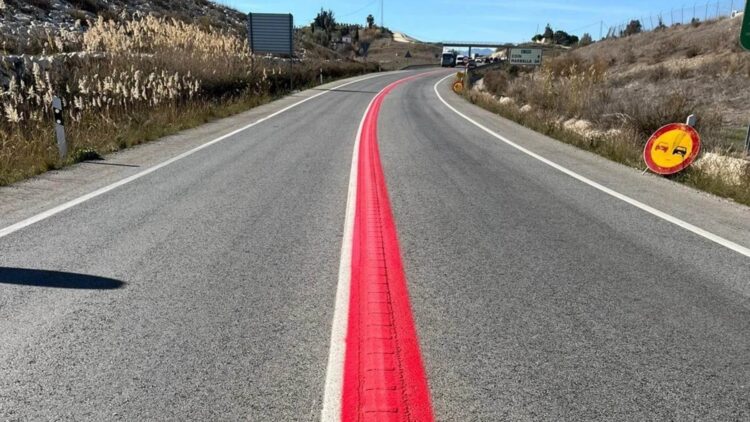
A bright red road here, a glowing green path there. Stripes running along the edges, circles marking curves, and even crosswalks turned into murals… Welcome to the latest trend in traffic safety. But what’s with all the street art?
It’s not just about making roads look cool, it’s actually a mind trick. When drivers or motorcyclists feel like they’re moving through a tighter space, their brains send a signal to slow down. The same effect happens when approaching an intersection covered in bright colors, it grabs attention and makes people more cautious without them even realizing it.
In short, painting the streets isn’t just decoration, it’s a sneaky way to make traffic safer. Turns out, a little color can do a lot more than just brighten up the commute
Mind games on the road: how paint tricks drivers into slowing down
Of course, the road isn’t actually getting narrower, it’s all in our heads. Studies show that a painted road surface creates a stronger sense of risk than a regular traffic sign. Why? Because signs can be ignored (we’ve all been guilty of that), but when drivers see less open space on the ground, their brains register a potential hazard, and instinct kicks in, they ease off the gas.
This isn’t just a theory; it’s being tested all over the world. And yes, Spain is getting in on the action too, trying out different painted road designs to see what works best. Turns out, a little paint can do what an entire signpost can’t, make drivers actually pay attention!
The great illusion: Slowing down with a splash of paint
It doesn’t matter if you’re in Scotland, the U.S. or even Malaysia. When it comes to driving, human brains work the same way everywhere. That’s why cities all over the world are using the same simple trick to tackle a common problem: painting the roads to make drivers slow down.
Some of the most eye-catching experiments have been tested in places built for cars, like the U.S., or in French towns where highways run right through local streets. Meanwhile, Spain has been experimenting near schools and in small towns, where pedestrians regularly share the road with vehicles.
The idea is simple: if drivers won’t hit the brakes on their own, trick their brains into doing it for them.
Painting the town safe: how street art is slowing down drivers
This isn’t just an experiment, it’s already making a difference. According to Bloomberg, New York City rolled out the Asphalt Art Initiative, a project that transforms dangerous intersections into giant, eye-catching murals. The goal? Make drivers pay more attention and slow down. And it’s working.
Before the project, half of all pedestrians hit by cars in these areas ended up injured. But after painting the roads, cars started driving more cautiously, and the number of injured pedestrians dropped to 37%. Turns out, a splash of color isn’t just for Instagram—it can save lives too.
The National Highway Traffic Safety Administration (NHTSA) warns that a pedestrian hit at 20 mph has a 90% chance of surviving, but at 30 mph, survival drops drastically. That’s why cities have been testing “dragon teeth” markings near schools, a pattern that creates the illusion of a narrower road, tricking drivers into hitting the brakes. At this rate, it won’t be long before more cities trade stop signs for paintbrushes.
Glow-in-the-dark roads: bright idea or just too pricey?
It’s a simple solution, but how well does it actually work? That’s still up for debate. What’s already clear, though, is that no amount of paint can fix a sky-high price tag.
Just ask Malaysia, where officials tried to light up the roads, literally. They used a special glow-in-the-dark paint to help drivers see where the road continued at night. Sounds brilliant, right? Well, there was one glaring problem: the cost. This futuristic paint turned out to be 20 times more expensive than regular road paint, making it more of a budget nightmare than a safety solution. At that price, it’s safe to say the idea didn’t have a bright future.