
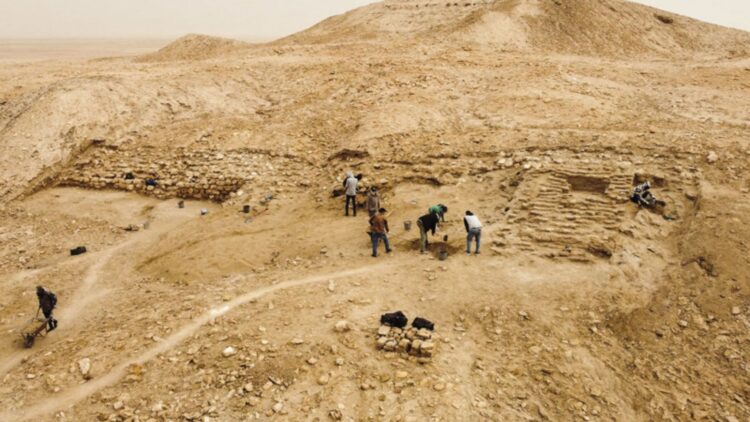
Ancient History is something that fascinates everyone interested in History, how the first communities were formed, the first writings, and an endless list of questions that come to mind when we talk, for example, about Mesopotamia or Egypt (beyond the fact that many believe these civilizations were sent by extraterrestrials and similar things). But there are discoveries that change everything without the need for gold or temples, just small traces are enough.
This is what happened with Eridu, a city forgotten by time that has resurfaced thanks to the water channels that once gave life to its lands.
Eridu: where it all began
Located in southern Mesopotamia, in present day Iraq, Eridu has been recognized by historians and archaeologists as the first city created by humanity. Not because of its size or wealth, but for what it symbolizes: the beginning of urban civilization.
Excavations have confirmed that the remains of this city date back, at the very least, to 5,000 years before Christ. Although this place was mentioned in ancient texts and Sumerian mythologies for centuries, there was still no physical evidence to help understand how it functioned at its peak. Until now.
The discovery
A team of researchers has identified a 7,000 years old canal system winding beneath the sands of southern Iraq. This complex hydraulic network of thousands of artificial streams not only supplied water to Eridu but was crucial in sustaining it and proving that planning existed much earlier than previously thought possible, because, as you might remember, Mesopotamia is considered the most advanced civilization of ancient history.
Water canals that gave life
As we said, this network of canals served to supply and allow life in this area. Now, researchers from Iraq, from Al’Qadisiyah University, have mapped 200 main canals and more than 4,000 secondary or smaller canals, and have even managed to find footprints dating back thousands of years, a marvellous discovery to help us better understand how our ancestors were organized.
Euphrates, symbol of life
The Euphrates River was essential for the development of life. While we know that water is important in any civilization or society, we must remember that during this era, without ways to transfer water, the largest and most important cities settled near rivers because the land in these areas is much more fertile.
For all of Mesopotamia, the Euphrates was one of its main pillars. With 3,000 kilometres in length, it carried water to all the crops in the nearby areas.
In the Eridu area, the Euphrates was much more stable, which allowed Eridu to survive until the year 500 B.C. However, its canal system became useless when the course of the river began to shift, leading the city to be abandoned forever and banished to the oblivion of time.
What was Mesopotamia?
Mesopotamia, which meant “between rivers”, was the region located between the Tigris and Euphrates Rivers and is considered the cradle of civilization, that is, the first civilization in history. Located in what we now know as Iraq and parts of Syria and Turkey, some of the first great cultures in history emerged there, such as the Sumerians, Akkadians, Babylonians, and Assyrians. It was there that cuneiform writing was invented, the first legal codes were created, and complex city-states were built. Mesopotamia marked a before and after in human history, transforming nomadic peoples into organized societies with administration, religion, commerce, and their own culture.
Preserving Eridu
Amid the debate over the climate crisis, this discovery highlights the wisdom of ancient civilizations. Eridu shows that as early as 5000 B.C., humans were capable of creating sustainable solutions to survive in extreme conditions.
But even though this place holds incalculable value in historical terms, Eridu is threatened by climate change, uncontrolled urbanization, and a lack of institutional protection. It’s not just stones and soil, it’s our roots as a civilization and as a species!!
Could it become a World Heritage Site?
Due to the relevance of the discovery, UNESCO recognized this little piece of land called Eridu as a World Heritage Site, not only for its antiquity, but for being an example of human ingenuity in its earliest stages.