
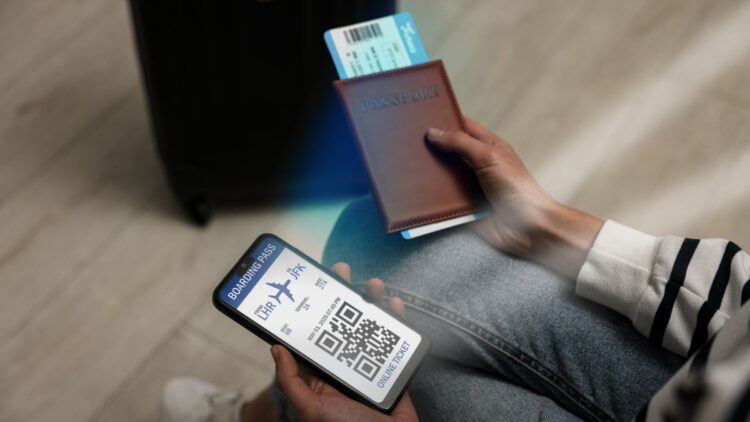
Air travel is about to modernize for good, and our classic paper boarding passes are about to become a thing of the past. The International Civil Aviation Organization (ICAO) is finalizing details to create a digital travel credential that will allow all passport data to be stored directly on your phone, with no need for paper (or to check 20 times if you’ve packed it). But this change goes beyond scanning a QR code. It’s about creating a digital identity that works internationally, eliminating the need to stop at a counter. Instead, travellers will download a “journey pass” that updates automatically if any flight information changes.
This way, airlines will know you’re ready to fly just by scanning your face, and boarding could be done without showing anything other than your face. A revolution or are we stepping into a Black Mirror episode? We’ll tell you everything below.
What is a digital credential?
In this case, it will be a digital extension of the physical passport, working just like your Wallet app (whether you’re team Android or team iOS). This credential will be stored on your phone and used for identification throughout your entire journey, from booking your flight to picking up your luggage from the carousel. One thing that stands out is that this credential will automatically update if your flight details change or get updated.
Your face will be your boarding pass
This system will work through identity verification, but not just any kind, it will use facial recognition. So, airport checkpoints won’t ask for documentation. Your face will be enough (both at check-in and at the gate). Travelers carrying only hand luggage will pass through checkpoints with facial verification only, quick and easy.
When will this technology arrive at airports?
While there’s no official date yet, some airlines are already testing the system. According to the product management director at Amadeus, the world’s largest travel technology company, this change is being studied alongside international bodies to ensure that it is safe, functional, and compatible across all countries, with a goal of implementing it gradually and synchronously worldwide.
She also explained that airport systems have barely evolved in nearly five decades precisely because of this, because they need to be implemented the same way everywhere. So, this change is meant to redesign how we access airports, aiming to become the new global standard.
Which airlines are already testing it?
The first bold ones to try this system have been British Airways, Air France-KLM, Finnair, and Saudia Airlines. They also claim that the new credential will allow them to offer a smoother, more modern, and personalized experience to passengers. Everything suggests that the major airlines are close to adopting the new digital identity as the standard.
Does this system have any advantages?
This system promises to eliminate lines and spare you from constantly checking if your tickets are with you. It’s expected that verification will be much easier (since you won’t have to show personal data) and that the experience will be contactless, fast, and secure. But, as always, anything tech-related comes with two risks. The first always relates to privacy, although it’s highly unlikely anyone could access this data, since your biometric information will be encrypted. The second relates to our elders, for whom anything technological is becoming increasingly difficult. From ATMs to new phones, anything tech-related is building a wall between generations, making many older people feel more and more excluded from society.
We’re getting closer to a fully digital society, but we shouldn’t forget that humans are social beings, and contact (even if it’s just to hand over your ID) isn’t a bad thing!