
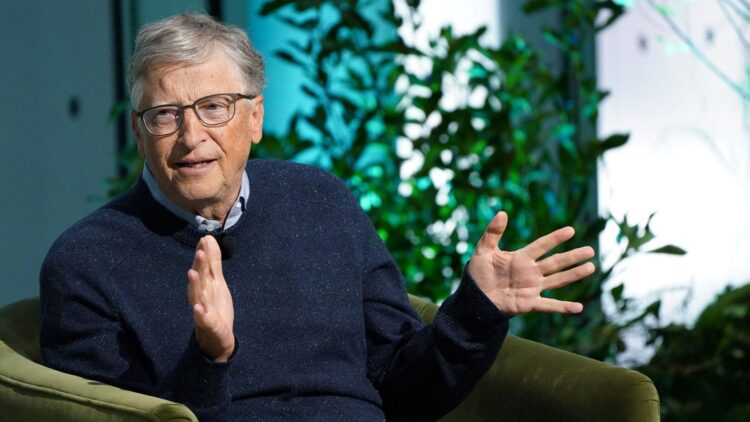
Bill Gates has frozen the world. Well, not literally, of course, but he has raised some questions that have left us cold: What if AI decided it no longer needs us? It sounds like a Black Mirror episode, but this reflection comes directly from the founder of Microsoft, who already warned a few years ago about pandemics and other global risks that would appear in the future, and now he returns with rather controversial statements. Gates does not intend to cause alarm, but wants us to be aware that this reality could happen in the very near future, and that, although AI helps us do our kids’ schoolwork, we also need to think that some things could go wrong.
Why is Gates afraid?
It’s ironic that Bill Gates, who was one of the pioneers of this technological revolution we’re living in, doesn’t hesitate to say that he is afraid of what’s coming. Every innovation that has occurred on this planet has completely transformed humanity, from the creation of the wheel to the birth of the internet. And everything, absolutely everything, has brought problems, even if it was a great advancement.
But, if you don’t take risks, you don’t win, and change can go hand in hand with logic and moderation.
AI is growing faster than we think
According to Gates, we are in the first stage of the Age of Artificial Intelligence. He compares it to the early days of the automobile, when there were no traffic lights, no rules, and no one knew how to react to an accident. That’s how we are right now with AI: amazed by its possibilities, but without a clear framework to control it. And here comes one of the ideas that most worries Gates and philosophers at Oxford University: the intelligence explosion. A theory that suggests that, at a certain point, AI could improve itself without human intervention at an uncontrollable speed… and not need a human to control it (or try to).
But… beyond being a paranoia, it is a real (and possible) scenario that we have to consider.
Deepfakes, disinformation and manipulated elections
One of the most immediate dangers that we are already seeing in countries around the world: deepfakes. Videos and audios generated by AI that seem real and are almost indistinguishable from reality. This type of video and document can change the course of, for example, an election with just a “publish” button.
Gates gives an example that is not so far-fetched: imagine that, two days before voting, a video goes viral showing a candidate committing a crime. Even if it’s later denied, the damage would already be done, and therefore, the elections manipulated even if not literally.
AI as a digital weapon
The other major concern that AI generates is cybersecurity. Artificial intelligences will not only know how to detect vulnerabilities in systems… they will also know how to exploit them. The result could range from bank robberies to cyberattacks between countries…
What does Gates propose for this?
He proposes creating a commission or international organization that is similar to the IAEA (International Atomic Energy Agency) but focused and specialized in AI, so that alarms go off when something steps out of line.
And what about our jobs?
Regarding the impact on the labour world, Gates is not so pessimistic. He believes that, as has happened before, many jobs will disappear, but new ones will also emerge. But special attention will need to be paid to how that transition is managed, and we need to learn to use AI as a tool and not as the entirety of the work.
And above all, democratize access to artificial intelligence to avoid creating a social gap even larger than the one that already exists today.
AI is not perfect
Another key point to address is that AI is not always right. It can make mistakes, generate false information or reflect human biases with which it was trained. That’s why Gates insists: it’s not about banning it, but about improving it, making it more diverse and educating those who use it.
Gates is not coming with a doomsday speech, but he is not turning a blind eye either. He knows AI is going to change everything. What is not so clear is whether that change will be positive or catastrophic.