
Finding Atlantis has always been the dream of everyone who, at some point, has dived into the sea. Now, a team of Spanish researchers has found some submerged structures off the coast of Lanzarote (Spain) that could match the real remains of the legendary Atlantis. According to the first analyses, they would be islands that sank under the ocean thousands of years ago, possibly during the last glaciation, and of course, everyone is excited. Is it the real Atlantis?
The discovery has been made by the Atlantis project of the IGME-CSIC, and, of course, it has not gone unnoticed, it has sparked debate among scientists and ancient history experts. These structures show beaches, cliffs and coastal dunes perfectly preserved, which indicates that they were part of an inhabited territory. Is this the most important archaeological discovery of the century? Some geologists think so, and we are going to tell you everything.
What is Atlantis?
Atlantis is a legendary island first mentioned by the Greek philosopher Plato in his dialogues Timaeus and Critias, more than two thousand years ago. According to Plato, it was an advanced civilization, rich in resources and technologically developed, that existed beyond the Pillars of Hercules (what we now know as the Strait of Gibraltar, located in Spain).
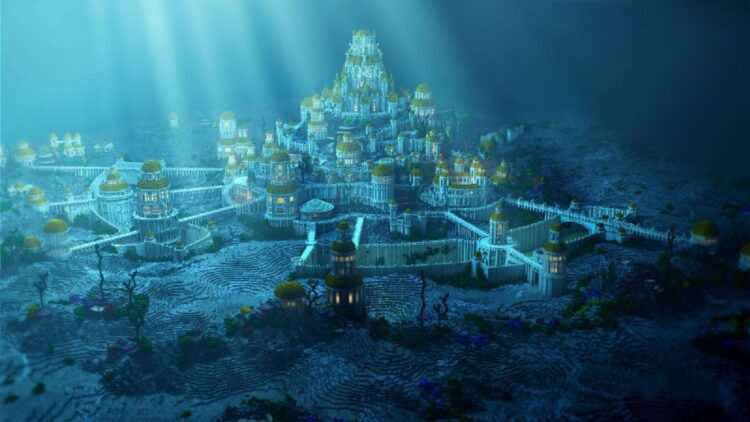
Plato described it as a huge island with a city built in concentric circles, with golden temples, majestic palaces, gardens, canals and a powerful army, basically paradise if we think about it. According to him, Atlantis tried to conquer other lands but was stopped by the ancient Athenians, and finally, in a single day and night of catastrophes, it sank into the sea and disappeared forever.
Since then, it has been the subject of speculation, conspiracy theories, massive investigations and fiction in popular imagination. Is it a myth? Was it real and did it sink due to a volcanic eruption?
The geological clues under the sea
Now, with the new islands discovered in Canary waters, that ancient hypothesis gains strength. The samples collected by underwater robots at 2,500 meters deep show signs of volcanic activity and coastal erosion, confirming that these lands were once above sea level. And the mystery remains.
An advanced society with access to precious metals
Plato also spoke of a civilization rich in gold, silver and exotic animals, organized in concentric circles with a majestic urban center. Although no artificial structures have yet been found, the fact that there are sunken island formations and evidence that they were inhabited opens the door for an ancient civilization to have thrived there before sea levels rose.
Could science confirm the myth?
Marine geologist Luis Somoza, from the Geological and Mining Institute of Spain, leads the project. His team used a submarine robot to collect fragments of soil and rocks solidified by lava, indicating ancient volcanic activity. These eruptions could have caused the ground to sink, leading to the disappearance of the islands, and going even further, it is possible that these submerged islands inspired the myth of Atlantis if a primitive civilization lived there and witnessed the sinking of that island.
Glaciations in the hidden history of the planet
During the last glaciation, sea levels were much lower. At the end of that period, the waters rose, slowly submerging coastal territories and many volcanic islands. If those islands housed human communities, the rise in sea level could have wiped them out. That is why there is “a solid basis” to reinterpret the myth as a distorted memory of a real geological event.
A new chapter for ancient history
Researchers will continue analyzing the samples to determine exactly when these islands became submerged. The goal is to establish a clear link between these geological formations and the story told by Plato. Although it cannot yet be confirmed 100% that it is Atlantis, the coincidences are enough to keep the legend alive.
And what if the myth was more real than we thought?
The discovery has brought Atlantis back to the centre of scientific debate, but this time not from speculation, but from data and direct observation. Maybe there are no crystal cities or impossible technologies, but it could be a civilization that succumbed to the power of nature, leaving a legacy that humanity has remembered in the form of legend for more than two millennia. What do you think?
| Aspect | Details |
| What was found | A massive underwater structure with geometric patterns resembling city blocks. |
| Location | Discovered in the Atlantic Ocean using sonar imaging. |
| Why it matters | Some believe it could be evidence of the long-lost city of Atlantis. |
| Reactions | Experts are divided: some are intrigued, others remain sceptical. |
| Scientific view | Geologists say it might be a natural formation or ancient seabed shifts. |
| Public impact | Social media is buzzing with theories, excitement, and debate. |
| Next steps | Further exploration is being planned to analyse the structure more closely. |
| Cultural context | The Atlantis myth comes from Plato, who described an advanced civilization lost to the sea. |