
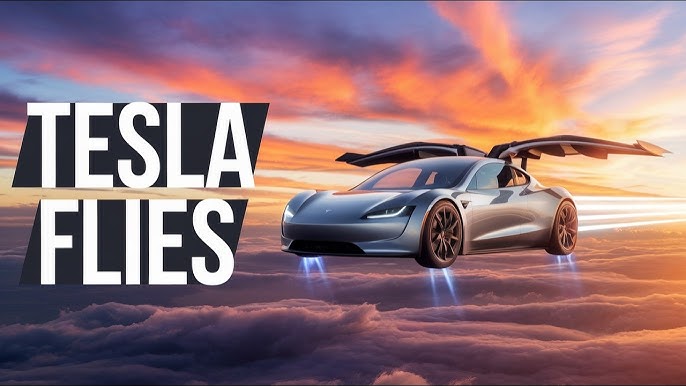
If you ever thought about what the future would be like, we bet anything that you imagined the future would have flying cars, right? It’s practically every kid’s dream and what appears in every futuristic movie. Well, we’re here to tell you that the future seems to have arrived and you’re driving in it (literally).
For decades, flying cars have been a dream left to science fiction. But today, that dream is starting to take off, literally. Elon Musk has confirmed that the new Tesla Roadster could feature flying capabilities, although it’s still in the design phase. But not only that, while the United States keeps dreaming, China already has active reservations for its first flying car: the Xpeng Land Aircraft Carrier! We’ve gone from the roads to competing to dominate the urban skies, and now it seems the future has propellers but the comfort of any family vehicle.
Musk launches the challenge: a Roadster that can fly
In June 2024, Elon Musk posted on his X account that the new Tesla Roadster would have the ability to fly. Far from shocking the world with his news, Musk has already shown that his ideas, although crazy and ambitious, end up becoming real. From Tesla to SpaceX, his track record in innovation is hard to ignore, so Musk, we believe you.
What is SpaceX?
SpaceX is another one of Elon Musk’s companies, and its main goal is to “democratize” space travel and make it possible for humans to reach Mars.
There have already been several space missions they’ve managed to launch and return from, starting with Falcon 1 (which placed a spacecraft in orbit and then returned to Earth) to the most recent mission in which, just a few weeks ago, for the first time, a group of women exited Earth’s stratosphere for 11 minutes (and they all came back alive, including the flower Katy Perry was holding in her hand).
Technology shared with SpaceX
And of course, since SpaceX and Tesla share the same owner, it’s clear that the Roadster will end up benefiting from SpaceX’s advancements.
This merging of technologies promises a revolution that combines ground mobility with vertical take-off capabilities. It’s not just another electric car: it would be the first serious step toward aerial mobility that could completely change the skyline of our cities.
What’s missing for it to become reality?
Although the idea is exciting, there are still obstacles to overcome. The most obvious is technical feasibility: flying requires a completely different design from current cars, and it’s not just about inserting a propeller. The challenges are more focused on reorganizing traffic. How will we know where our cars can fly? How will that be regulated? At how many meters off the ground? And accidents, how will those be prevented? And of course, all those changes will be expensive. Very expensive. And still very hard to solve.
China hits the gas with Xpeng
While Tesla continues perfecting its Roadster, the Chinese company Xpeng AeroHT has taken the lead and already presented a functional model called Land Aircraft Carrier. This hybrid car already has around 2,000 vehicles in presale and is expected to hit the market in 2026. The estimated price: $280,000, no less.
The paradigm shift is already underway
Innovation in mobility no longer depends solely on electric motors. Now the focus is on solutions that eliminate traffic and expand the city toward the sky. China knows this and is investing big. If Tesla wants to lead this race, it will have to move fast.
Who will win the sky?
The future of flying cars is not yet in anyone’s hands. Even though Tesla has the media and tech lead in many areas, Chinese manufacturers are showing surprising speed and precision.
Are we about to see the first Tesla take off? Maybe yes. But if Elon Musk wants his brand to be the one that opens the sky, he’ll have to break an innovation record before Xpeng turns into reality what until now was just science fiction.