
A group of astronomers has just found something in the atmosphere of a planet outside our solar system (a very distant one), and it has caught their attention quite a bit: It could be a clue, still a very tiny one, that we are not alone in the universe. Are we really facing the first proof of life outside our planet?
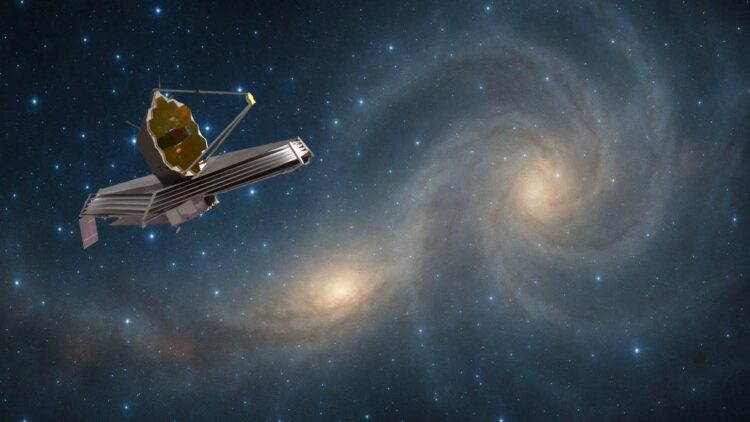
The James Webb Telescope has been the protagonist of this discovery, as expected, since it is the most advanced telescope created by humans and launched into space so far. If you did not know, this telescope is located quite far from our planet and is capable of capturing primitive galaxies that are millions of light-years away (more or less, from when our planet was just beginning to form).
Through it, scientists observed the planet K2-18b and found traces of dimethyl sulphide, a molecule that, on Earth, is produced almost exclusively by living organisms. Are we really facing the first concrete indication of life beyond our planet, or are there other explanations?
It is still too early to draw conclusions. Although it could be a before and after in the search for life, the researchers themselves remind us that there is still a lot of work ahead. From now on, enthusiasm and scepticism will have to go hand in hand. We tell you everything that has been discovered so far below.
K2-18b, what is it??
K2-18b is not just any planet. It was the 18th planet discovered by NASA’s Kepler mission, and that “b” in its name means it was the first system found (hence its full name, it is not very original, but it works for us).
K2-18b is relatively close in galactic terms, but it is very different from Earth. To begin with, it has about eight times more mass than our planet and its volume is 18 times greater. That means it is probably not a rocky world like ours, but rather one covered by a very dense atmosphere or even by huge oceans (and you already know what happens when there is water, right?)
Scientists are handling several hypotheses, the first one is that we could be talking about a “mini-Neptune” or a “gas dwarf.” However, there is an idea that is sounding stronger and stronger: that it is a “hycean world,” meaning a planet covered by a global ocean under a hydrogen atmosphere.
What is that of a hycean world?
Imagine gigantic oceans, much deeper than those on Earth, without a single continent in sight. That is how a hycean world would be. Its hydrogen atmosphere would allow maintaining temperatures compatible with life as we know it.
The finding of dimethyl sulphide: a sign of life?
During their observations, astronomers captured a faint signal that corresponds to dimethyl sulphide (DMS). On Earth, this molecule is mainly emitted by marine phytoplankton, and there are practically no known non-biological sources that produce this molecule.
That is what has caught the researchers’ attention, because this discovery opens the possibility that there is biological activity on this planet, although of course, they do not necessarily have to be forms of life that are known so far.
Now it is time to confirm
Despite the excitement, researchers know they cannot confirm anything yet. They are reviewing the data with a magnifying glass, and more detailed observations will be needed to confirm if it really is dimethyl sulphide… or if it is some similar compound that has appeared on the scene.
Until those two things are clear, talking about life would be getting too far ahead, and when it comes to discoveries this big, science is very strict: extraordinary evidence is needed. The detection of dimethyl sulphide is a huge step, yes, but by no means a definitive proof of life on K2-18b.
What are scientists going to do now?
The plan is to continue observing K2-18b and other possible hycean worlds to look for patterns. If they find biomarkers like DMS on more planets, they could start to draw stronger conclusions.
Whatever happens with K2-18b, it is clear that we are entering a new era for astrobiology. Thanks to telescopes like James Webb, now we can analyse distant planets with a precision that until recently seemed like science fiction.
Meanwhile, that eternal question keeps floating up there, among the stars: Are we really alone? So exciting.