
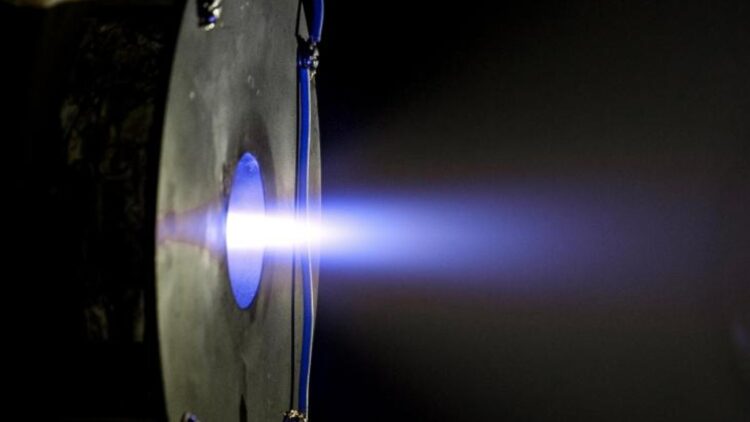
While half the world is still arguing about whether the future lies in electric cars or if hydrogen is the better option, China has decided to skip the debate and look straight to the stars. Literally. They have just unveiled a space engine that runs on plasma, the liquid matter that makes lightning, the northern lights… and the Sun itself, possible. Are they crazy?
Well, this isn’t just any prototype, neither a joke. This engine has already surpassed the 100-kilowatt power mark, something that, in the world of space propulsion, is a huge milestone. So big, in fact, that it could mark the beginning of a new way of travelling through space. And maybe even a new way to generate energy here on Earth.
What is plasma and why is it so special?
Plasma is the fourth state of matter (the other three are solid, liquid, and gas). It forms when you heat a gas so much that its atoms break apart and release charged electrons and ions. It’s electric chaos, yes, but it can be controlled with magnetic fields to generate movement.
On Earth, we see it now and then in the form of lightning or the aurora borealis. But in the universe… It’s everywhere. It’s the most abundant state of matter. The challenge has always been to control it without everything blowing up along the way.
So how does the engine work?
It’s called a magnetoplasmadynamic (MPD) engine. It doesn’t burn fuel. What it does is ionize a gas (like argon or xenon), turn it into plasma, and then expel it at high speed using electromagnetic fields. The result is continuous thrust, stable and much more efficient than traditional chemical engines.
Until now, these engines typically operated at 10 or 50 kilowatts. The new Chinese model has reached 100!!! But on top of that, it has been built with high-temperature superconducting magnets and 3D-printed components, which makes it lighter, more durable, and easier to scale up.
On Earth, just like in the stars…!
Chemical propulsion (like that of classic rockets) is powerful but short-lived. To travel far in space, you need an engine that doesn’t have to stop to refuel constantly. And that’s where plasma might come in: it can push slowly, but without stopping.
This opens the door to longer missions, cheaper ones, and with fewer limitations. Missions to Mars, for example. Or even further.
China is thinking big
While Tesla continues to launch electric cars in the West and Japan bets on hydrogen, China has turned to the oldest material in the universe: plasma. And they haven’t stopped there. Maybe it will even reach us in a future vehicle project, though there’s still research to be done and probably many years until we see it on our roads.
This new engine is one more step in engineering, perhaps they’ve just positioned themselves as candidates to lead the energy revolution we so desperately need. And it didn’t require hydrogen, lithium batteries, or sodium ones, just a material as old as the universe itself: plasma!