
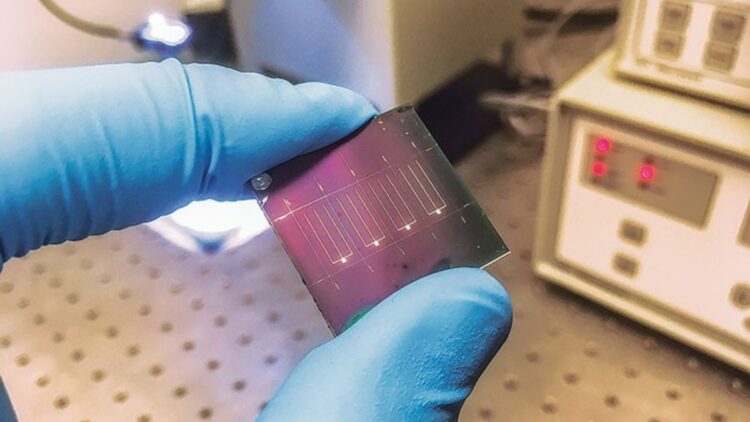
Until now, talking about solar energy meant talking about large silicon panels, and then perovskite panels appeared, everything revolved around them, but in a world heading toward clean energy, they weren’t enough. So, research continued to find more options. That’s how a new name came onto the table: kesterite. Although it sounds like a Pokémon, this compound is made with zinc, tin and sulphur, and if you prefer its technical name, it’s CZTS. And of course, since we love new developments, this one has become quite interesting. No toxic materials or expensive elements. And all thanks to one specific technique: hydrogen passivation, which has greatly improved its efficiency. Want to know more?
Kesterite: the new trend
In Australia, a team at the University of New South Wales, led by Professor Xiaojing Hao, has achieved something unthinkable: a record 13.2% efficiency with kesterite solar cells. It may sound like little, but it’s not. They came from 11.4%, and this is a huge leap in a field where every tenth of a percent matters. This was made possible thanks to hydrogen passivation, a technique that neutralizes microscopic defects that previously limited the performance of CZTS.
And why is it so important?
Because until now, the Achilles heel of kesterite was exactly that: it didn’t perform well enough. And of course, no matter how sustainable or cheap it is, if it doesn’t convert light into energy efficiently, it’s useless. But now it’s starting to be competitive. Not to replace silicon, but to complement it. In multi-layered panels, it can capture wavelengths that silicon doesn’t take advantage of, and that adds up to much more energy per square meter.
Cleaner than perovskite
Unlike perovskite (which contains lead and has stability problems), kesterite is stable, non-toxic and can be installed almost anywhere, even in sensitive or rural areas where there aren’t any technicians nearby to fix things if they break.
And that’s very valuable. We’re not just talking about efficiency, but also about safety.
China and Malaysia join the game
This isn’t just an Australian thing. Researchers in China and Malaysia are testing new CZTS cell configurations with a layer of tungsten oxide (WO₃) and a CZTSe rear contact. The result? A theoretical efficiency of 29.3%, which even surpasses many current silicon-based technologies.
And the best part: this new design doesn’t use cadmium sulphide, a toxic material still present in many solar cells. Tungsten oxide is safer, cheaper and maintains good conductivity. An improvement in every sense.
What’s missing for it to be used at large scale?
According to Professor Hao, the point of no return would be reaching 20% efficiency. If they achieve that, it will be hard for the industry to ignore this technology. They’re talking about 2030 as a realistic date for mass adoption, but at the pace they’re going, we could see it earlier in specific applications.
Clean energy can also come from recycled ideas
Kesterite isn’t a new invention, but a material that’s been around for a while and nobody had paid attention to yet, it hadn’t found its moment… until now. What was once dismissed for being inefficient is now back in the conversation with solid arguments: it’s durable, cheap, sustainable and doesn’t require rare or dangerous metals.
And that’s exactly what we need in a real energy transition: solutions that work on a large scale, without risks and without detours.