
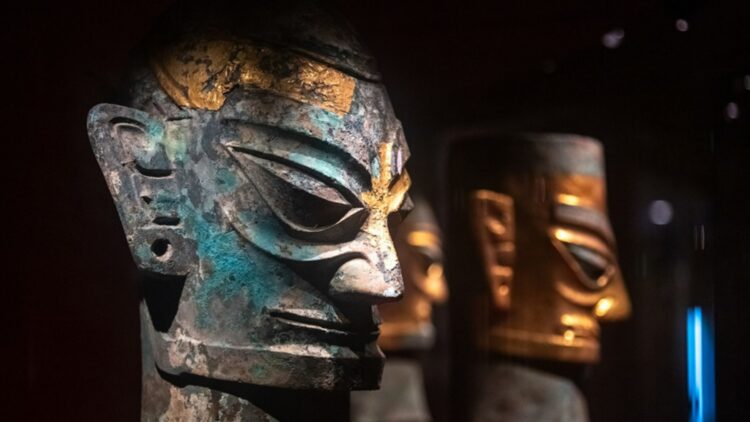
In the ancient region of Sichuan, in China, for millennia, a city has been completely forgotten. The dynasties that came and went preferred to settle in other parts of the country, leaving the Kingdom of Shu aside. As we said, for millennia it has remained hidden in the shadows, but this area was splendid during the Bronze Age, or so we thought until now. The latest archaeological discoveries have revealed that this area was not only a prosperous kingdom but also a place of artisanal production of luxury items! Over 3,000 years of history have remained forgotten, but now, bronze masks, mythological trees, golden sceptres, and never-before-seen sculptures have stolen the show. Want to know what the Kingdom of Shu is? We’ll tell you below.
Sanxingdui, the place that changes everything.
Shu was, for a time, just a name, something that existed but passed without much importance through the annals of history, until 1929, when Shu began to materialize thanks to archaeology. Some excavations near the Yazi River uncovered a walled city from the Bronze Age, which they named Sanxingdui, “three stars”, Located in Sichuan, northeast of modern-day Chengdu, they discovered a city covered in jade.
A different kind of art
Archaeologists found more than a thousand pieces: bronze masks with bulging eyes, golden scepters decorated with birds and fish, and even a sacred bronze tree four meters tall with fantastic creatures on its branches. Nothing like the sober and geometric art of the Shang, or anything seen before. What we see here is unleashed imagination, mysticism, and a style so unique it drew attention from everyone who saw it.
The artisans in Shang produced geometric vessels, but the figures of Sanxingdui were different, with large ears, strange smiles, and most importantly and curiously, they were not made of a single piece, but of parts that were later assembled, like LEGO, but in bronze, jade, and ivory, and from 1200 B.C.!!
A powerful workshop
This monumental workshop was not just a place to make pretty things. There, high-level materials were used, jade, ivory, silk, gold… and rituals were also performed. In 2024, they found a jade processing area with ritual axes and daggers, and alongside that, wooden chests, fabric remains, and jewels. Everything points to it being both a production centre and a sacred space.
Eight pits, more than 17,000 pieces
Researchers have spent years with all five senses focused on this area of the Asian country, and the excavations have revealed eight aligned pits, from which more than 17,000 objects have emerged, many of them in perfect condition. Human figures, mythological animals, ritual scenes… An entire spiritual universe reflected in every detail.
Among the most striking: a divine figure with bird legs, a ceremonial vessel, and a priestly figure with a dragon-shaped staff, assembled from fragments that were scattered across several pits. Doesn’t the worldview of those artisans seem fascinating?
What happened to Sanxingdui?
It’s still unknown. The historical context suggests the pits were created between 1100 and 1050 B.C., when the area faced a war between the Shang and Zhou dynasties. Because of this, it is believed that Shu may have been governed by two main groups, and that the struggle for power in the area may have ended with the complete destruction of the city.
Are there only objects?
The incredible answer is yes, there are only objects. They haven’t found anything written yet. How did they read? It’s believed they used silk or other materials that turned out to be perishable. But despite no written elements having survived, the art and the objects have left us a very important clue: the people of Shu were artists, were spiritual, and very different from anything we had imagined. What a wonder the history of our planet is!