
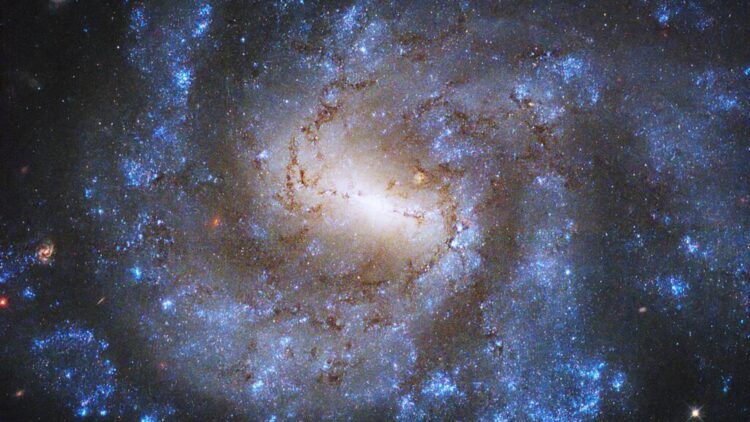
Hubble just gave us some very important information, yes, we’re talking about the Hubble Space Telescope. So, apparently, 64 million light years away from Earth (far, far away) in the constellation of Eridanus, NGC 685 shines tirelessly. Ok but, what is it? Wait for it, it is a barred spiral galaxy bursting with life in the form of thousands of newborn stars. Almost like a neonatal hospital for stars! And Hubble discovered it all by itself! Astronomers managed to capture this galaxy: spiral arms full of blue clusters and pink clouds, where star formation is at its peak… Something incredible.
Now you’re probably wondering, who is NGC 685, right? Well, stay with us and we’ll tell you everything.
Who is NGC 685?
Smaller than our Milky Way, it’s a cosmic spectacle that appears in the distance and vastness of the universe. In its light, experts are able to discover how stars are born,isn’t it incredible?!
The youthful energy of NGC 685
Even though NGC 685 isn’t as big as our galaxy, it shares the same beautiful structure: a bright central bar with spiral arms that seem to stretch out like elegant ribbons. It’s right in these arms that pink clouds, called H II regions, appear, places where gas glows brightly as young, hot stars burst into life
But the researchers noticed something very interesting and incredible!: the arms of this galaxy stand out for being blue, meaning they are home to newborn stars. These stars are much hotter than our Sun and illuminate the surrounding gas clouds, creating a fleeting but spectacular glow.
The H II regions: cradles of stars
The H II regions are the stage where stellar life begins. These clouds shine intensely thanks to the radiation from the young stars, but their luminosity is short-lived: once the mature stars disperse the gas, the glow disappears… A real spectacle, what a marvel!
Hubble, James Webb and ALMA: the Dream Team
Hubble’s data for these observation programs will allow scientists to catalog 50,000 H II regions and 100,000 star clusters in nearby galaxies. But Hubble is not alone: the James Webb Space Telescope contributes infrared data, while the Atacama Large Millimeter/submillimeter Array (ALMA) adds radio observations, as the kids these days would say “the complete package”.
And the combination of these three instruments allows astronomers to explore the dustiest corners of galaxies, where stars are born. Thus, NGC 685 becomes a perfect laboratory to understand how these bright points of light form and evolve.
Keys to understanding our place in the cosmos
As you may know, studying galaxies like NGC 685 is not just about admiring their beauty. Each image and each piece of data bring us closer to understanding how stars are born, live, and die. This knowledge is essential to decipher the history of the universe and, ultimately, our own!
Between science and wonder
When we see images like those from Hubble, we understand that science and emotion can go hand in hand. Spiral galaxies like NGC 685 make us reflect on the immensity and dynamism of a universe that always has something new to show us, and how small we really are!
Beyond our own planet, we also discover that there is poetry in the way other galaxies are created, pink clouds, bluish clouds… What a sight, could there be life out there too? Who knows!