
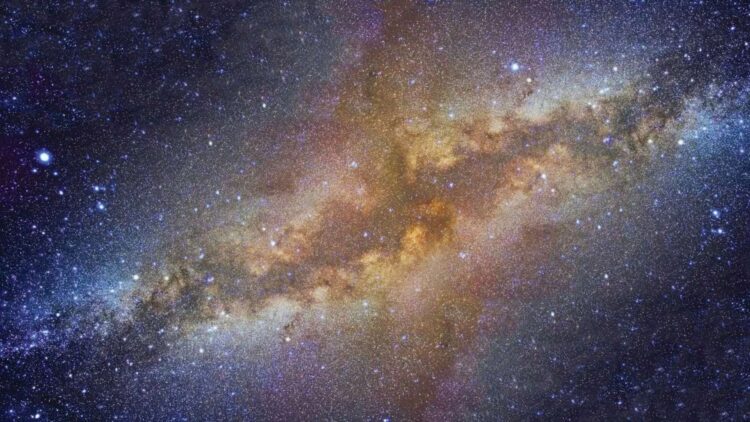
It’s June… look up! We’re not joking, if you love astronomy, look up! This month will be especially beautiful to observe the Milky Way and its core. If you love the night sky, June brings you the best chance to enjoy our galaxy, to connect with the universe… a spectacle! Beyond the light with which we’ll see our Milky Way, June brings us much more, Venus and Saturn meeting at dawn, Mars brushing against Regulus, and Mercury making an appearance as the sun sets… And all during the June solstice. Could there be more magic in this month?
The heart of our galaxy
The core of the Milky Way isn’t something you see every month… But in June it can be seen practically every night, of course you’ll have to go far away from light pollution, like during a shooting star shower.
So, pay special attention because you’ll see a galactic central bulge full of stars and stardust with a very soft glow, like a cloud crossing the sky, it will look like a spell!
But… how do I know where it is?
Okay, let’s locate it, just look south from a dark place (remember to be far away from light pollution). There it will rise like an arch connecting the entire horizon with a view that you probably have never seen before!
But, if you’re a bit clumsy (we’re listening but not judging) there are apps like SkyWalker2 that will tell you where to look, as well as explaining many more curiosities of our universe.
What will we see in the sky?
- Venus and Saturn will share the dawn, yes. Venus will rise about two hours before sunrise, and Saturn will appear at 3 AM and climb higher in the sky while moving away from Venus.
- Mars and Regulus will have a very brief encounter on June 16 and 17. Mars will rise in the western sky at sunset, but on the 16th and 17th it will approach the brightest star of the Leo constellation, they will be as close as the full moon, doesn’t that sound amazing?
- Mercury will appear in the last nights of the month, shyly, but it will appear 30 minutes after sunset very close to the western horizon.
- Lastly, we have Jupiter, which will be visible only in the first days of the month alongside the glow of the setting sun, but it will stop being visible until early July.
The June solstice
The June solstice, which happens on the night of the 20th, will mark the highest point of the sun in the sky for the northern hemisphere, and the longest day of the year! It’s the day when the summer vibes are felt the strongest.
This happens because as you already know (unless you’re a flat-earther, who surely has another explanation) that the Earth is tilted on its axis. In June, the northern hemisphere is tilted towards the Sun, which lengthens the days and shortens the nights. For the southern hemisphere, it’s the opposite: it’s the start of winter and the shortest day of the year (it seems strange to us that you wear a parka in July, really).
Highlighted calendars:
- On June 19, the Moon (in its last quarter) and Saturn will rise together at 1:30 AM.
- On the 22nd, the Moon and Venus will cross in the sky at 3 AM.
- June 20th will be the Summer Solstice, also called Midsommar (but here we’re not going to cover anyone in flowers).
- June 16 and 17 will be when Mars and Leo get close.
- June 21-30 Mercury will appear.
The connection with the sky
Since ancient times, the solstice has been a reason for celebrations and rituals. Monuments like Stonehenge or Chichén Itzá are aligned with the solstice, showing that our cultures have always looked to the sky to find answers and meaning, just as in Europe they celebrate the solstice near the sea because this day has magic!
So, if you’re a great lover of the sky, of astronomy and of lying on your back anywhere to observe what’s up there while watching a spectacle of twinkling lights in the sky… this is without a doubt your month!