
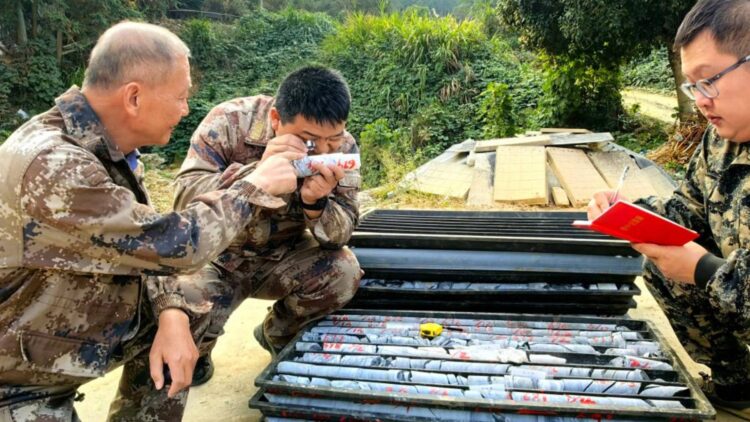
They have found a giant gold deposit in China’s Hunan province with estimated reserves of 1,000 tons and a value exceeding US$80 billion!!!
And it’s clear this is a turning point in the geopolitics of precious metals, as it could be one of the largest gold deposits in the world (or at least among the discovered ones). The size of the vein, the exceptional quality of the ore, and China’s role as the world’s top gold producer… Everything that’s coming next for the gold industry is going to bring changes. Want to know more?
A record-breaking discovery
The Hunan Geological Bureau announced they had detected 40 high-grade veins in Pingjiang County. Each metric ton contains an average of around 138 grams (about 5 ounces) of gold, which is incredible for miners.
And according to the first 3D models, the mineralization extends down to 3 kilometers!!! Truly an unprecedented volume for the global gold industry. Of course, markets have responded and have placed China as the leading power in gold extraction.
Markets on the rise
Of course this discovery triggered a rise in the markets. Even though commercial exploitation will still take years, the global economy took notice of the news.
Impact on strategic reserves
China already exceeds 2,000 tons in official reserves. With this deposit, Beijing could strengthen its financial arsenal without relying on other markets, just by reducing pressure on the dollar and diversifying its currency cushion. Incredible!!!
If the planned extraction becomes a reality, the country would control more than 15% of the world’s raw gold all by itself!
John Reade, a senior market strategist from the WGC, said that China’s potential resource sounds quite ambitious (referring to the 1,000 tons) and he doesn’t believe China will be able to turn that much gold into reserves.
How much does the global market produce?
It’s estimated that the global market surpasses 3,600 tons a year (about 127 million ounces), and Reade believes that just because a mine surpasses one million ounces a year, it won’t change much in the global market.
How did such a massive deposit form?
The Pingjiang region is located in the Yangtze tectonic belt, an area of intense geological activity where faults rich in hydrothermal fluids converge. Over millions of years, those fluids precipitated gold particles into deep cracks, generating the veins that have now been discovered.
The process is similar to that of all existing deposits, but what stands out is the concentration found in this mine.
How was it found?
You won’t believe it: artificial intelligence! Yes, they used AI-guided drilling processes, high-resolution sensors, seismic mapping algorithms, and spectral analysis of cores, which made it possible to identify signals that would have gone unnoticed just a decade ago.
Environmental challenges…
Extracting gold at depths greater than 2,000 meters presents complex challenges: managing acid water, energy consumption, and coexistence with rural communities…
Many Chinese NGOs are demanding transparency and citizen participation to ensure that the project carried out is as non-invasive as possible.
Boost to technological innovation
The entry of additional tons of gold could accelerate developments in electronics, health, and energy. The metal is irreplaceable in high-performance microchips and emerging technologies like fusion reactor coatings or quantum photonics. By securing domestic raw material, China would gain a competitive edge in strategic sectors.
What is gold used for today?
Mainly and most obviously, gold is used as a safe haven for future economic crises, since the gold a country possesses becomes part of its reserve.
But today, what matters most is technology and electronics, as gold is an excellent conductor of electricity. Believe it or not, your phone and your computer contain components made with gold!
So, China is getting ready to lead the tech race by controlling a resource that’s quite scarce. The whole world is looking at Pingjiang, the epicenter of what could be the biggest gold rush of the 21st century!!