
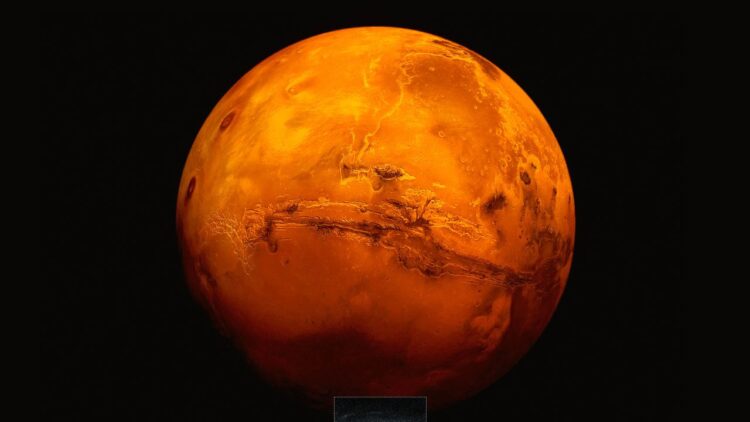
Mars continues to be the planet that captures our attention the most, and for years it was believed that this planet was devastated by nuclear bombs millions of years ago… The hypotheses about the red giant are fascinating, from the idea that living beings like us inhabited it, to, well, wherever human imagination can reach!
Now, NASA has sent several probes to Mars in search of signs of past life because they believe it had rivers, lakes, and oceans that were similar to our planet. Incredible, considering it’s a red fireball, right?
All these hypotheses are supported by the concentrations of xenon-129 and the presence of thorium and uranium already detected by other NASA probes. But… how true is this? Let’s break it down!
The root of the myth of life on Mars
It all began in 1976, when the cameras on the Viking 1 probe photographed the famous “Face on Mars” in the Cydonia region. At the same time, the onboard spectrometers found very strange proportions of xenon-129, an isotope that on Earth appears after nuclear tests.
The scientist John Brandenburg, fascinated by these data, first proposed the existence of natural reactors and later, artificial thermonuclear explosions that would have erased ancient civilizations. So, this scientist believes that in the past there were nuclear reactors just like the ones we have today on Earth.
On Mars, they found high concentrations of radioactive uranium, thorium, and potassium, and indeed, in a very distant past, there were thermonuclear detonations. Where did they come from?
Well, the theory goes like this: these primitive civilizations (Cydonians and Utopians) were exterminated by high concentrations of harmful gases. There were even images showing the face of a man (although it was probably just pareidolia).
The “Face on Mars” captured by NASA’s Viking 1 orbiter in 1976 (1st image) and Mars Global Surveyor in 2001 (2nd image). pic.twitter.com/jVkPqwMcoW
— World of Engineering (@engineers_feed) June 4, 2025
Goodbye to the theories
ASA has refuted all the supposed evidence for this theory, and they explained that, first, the images are an optical illusion caused by the light, even if it looks like there are images of human beings.
The SAM instrument (Sample Analysis at Mars) on the Curiosity rover analyzed air and rock samples for more than a decade. Its results indicate that between 65% and 80% of the planet’s original atmosphere was lost due to solar wind because of Mars’s weak magnetosphere. And clearly, this process also explains the concentration of rare gases. There were no humans on Mars.
Thorium, uranium, and potassium
The Mars Odyssey orbiter mapped and monitored thorium and uranium deposits in the crust, but their distribution matches ancient basaltic lava flows and not nuclear impact craters… On Earth, there is a similar natural precedent: the fossil reactor of Oklo (Gabon), where uranium reached criticality 1.7 billion years ago. On Mars, the prolonged lack of liquid water would have prevented any sustained chain reaction.
Myths that refuse to die
The theory of a Martian armageddon has been fueled by blurry images, clickbait headlines, and human fascination with cosmic disasters… Even so, it lacks peer-reviewed evidence. NASA itself emphasizes that the “Face on Cydonia” is an optical illusion: higher-resolution photographs show an eroded hill with no artificial features.
What we do know about Mars’s past
3.5 billion years ago, Mars had oceans, rivers, and possibly habitable conditions.
Its reddish color is due to the iron oxide covering the surface, as if it were coated with rust dust. We also know it has giant volcanoes, like Olympus Mons, the tallest in the solar system.
The interesting part is that much of that atmosphere was gradually lost, blown away by the solar wind when the planet stopped having a magnetic field to protect it, unlike Earth.
Search for life?
Programs like ExoMars or Mars Sample Return will analyze sealed rocks in search of biosignatures. If life ever existed on Mars, it’s more likely it succumbed to extreme climate changes than to hypothetical war detonations… don’t you think?
Science is advancing, and little by little we’re learning what Mars and other planets in the solar system were like billions of years ago. The geological processes of the Milky Way are, without a doubt, incredible and super interesting. What else might Curiosity have in store for us?