
NASA is giving the world another fascinating discovery! Current astronomy’s basics have been challenged by the new NASA finding and the theories about planetary formation have been called into question. Scientists, by using satellites and telescopes, have detected a huge gas planet orbiting around a tiny red star. The striking thing about this NASA finding is that a star that tiny shouldn’t have the capacity to form a planet that big, but it has!
Let’s see more about this finding that has astronomers so intrigued that it could also mean the change of what was understood about the evolution of planetary systems in space.
New NASA finding that ‘’shouldn’t exist’’
A recent finding by NASA (National Aeronautics and Space Administration) has challenged well accepted scientific models about how planets are formed. Astronomers think this NASA finding shouldn’t exist because it was thought to be possible a huge planet orbiting a red tiny star. This goes against the accretion of the core model.
TOI-6894b
This peculiar name, as most of NASA’s findings, is how the planet NASA recently found is called. TOI-6894b is a huge gas planet that orbits a star with low mass. This red and tiny star was located around 241 light years from Earth in the constellation of Leo.
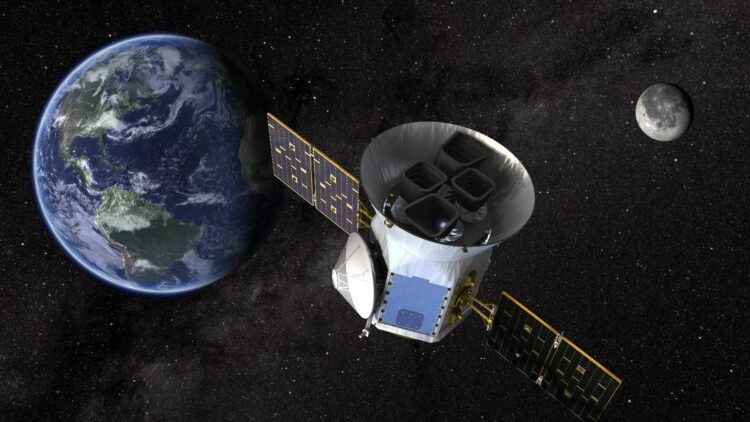
As always, special tools were required for detecting this peculiar situation. First, the TESS (Transiting Exoplanet Survey Satellite) satellite was the one that detected regular falls of light in stars, indicating a planet is passing in front of them. Then, the VLT (Very Large Telescope) confirmed what the previous telescope detected.
What do we know about this planet?
It’s compared to Saturn in size and some features, but let’s focus on what TOI-6894b unique features have:
- Its mass is slightly larger than half of Saturn’s.
- Its diameter is 1.07 bigger than Saturn’s.
- Its density is very low, something characteristic of gas planets.
However, the most striking thing about this planet is the fact that it orbits really close to its star and completes its orbit in less than 3 days.
The accretion of the core
Accretion of the core is the most accepted model by astronomers when it comes to planet formation. According to this theory, huge planets like Saturn or Jupiter are first formed as small rocky cores that later attract huge amounts of gas from the protoplanetary disk surrounding a new star. However, for this to happen it’s required a huge amount of dust and gas in this disk.
What’s the issue with TOI-6894b then? The red tiny stars in the TOI-6894b system are cold and small, so they shouldn’t have protoplanetary disks thick enough to form planets that big. This is why this NASA finding is so striking for scientists.
What about the future?
NASA’s TOI-6894b existence has been confirmed, but there is more to discover about this planet and its star. For this reason, scientists are planning on using the James Webb Space Telescope (JWST), which is the most powerful to study the atmosphere and exoplanets’ inner structure with so much detail.
With this plan, scientists expect to make clear the planet’s core size, measure its atmosphere composition (how much hydrogen and helium) and better understand how this huge planet could be formed having in mind its limited situation.
NASA never stops surprising us nor scientists, this finding has gone against a studied theory in the astronomy field which strengthens the idea of how unknown space is. We never know what we will learn from space and NASA missions because they are exploring a mysterious place where everything works in a different way than here on Earth. Aren’t you excited about the next NASA discovery?