
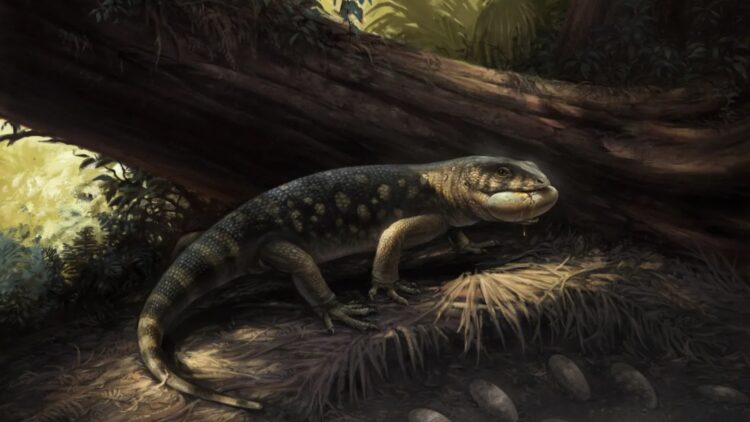
Remains of a prehistoric lizard have been found at the Museum of Natural History in Utah. All started with a jar that went unnoticed for many years, but one day a prehistoric lizard, that lived 76 million years ago along with dinosaurs, was found in a jar. The name of this lizard is Bolg amondol and it shows valuable information on Cretaceous ecosystems. This finding proves that important things can be found at museums if they are checked in detail.
This is a surprising discovery that will be useful for future palaeontology studies to understand what’s happening now taking into account the past. So, let’s start with the story of this lizard!
An unexpected discovery at a museum
Imagine you work at a museum, in the Museum of Natural History of Utah to be more concrete, and you see a jar labeled as ‘’lizard’’ everyday. You are so used to seeing it that you don’t give it importance, until one day a group of scientists from the Natural History Museum of Los Angeles wanted to analyze it. They found out inside this jar there were remains of an unknown prehistoric lizard that lived around 76 million years ago, during the Late Cretaceous period.
The lizard
This lizard, Bolg amondol, was named after a character from the story of J.R.R. Tolkien and using words in Sindarin (Elfic language made up by the author). Its name draws attention to its head covered in bone mounds, which was very similar in appearance to the monsters in the fantasy story.
What scientists found after analyzing the lizard was it was covered in bone plates that were used as a natural shield and, thanks to its sharp teeth, it became a small but efficient predator.
Small but…
Although the lizard’s size was not a dinosaur’s size, it was good at hunting. The way it did it was probably by hunting dinosaurs’ babies or smaller animals than Bolg. We shouldn’t underestimate small animals, they are so smart with their hunting strategies…
The forgotten fossil with a huge scientific value
The most interesting aspect about this discovery was that the lizard was found during material checking from 2005, during an expedition to the Grand Staircase-Escalante National Monument. Blog’s bones were kept in a jar without any detailed study, but this changed when Hank Woolley (paleontologist) examined them and realized they were part of a partial skeleton of a creature never registered.
Cretaceous ecosystem history
This lizard gave new information about the range of reptiles that coexisted with dinosaurs, and strengthened the idea of Cretaceous ecosystems being more complex than scientists thought. What’s more, there are evident evolutive connections between species from North America and Asia, since Blog’s ‘’relatives’’ were found at the Gobi desert. This reinforces the theory on the existence of migration routes between continents through the ancient bridge of Bering.
Checking scientific archives
This lizard finding also showed the valuable role of museums and their collections. Sometimes, there’s no need to do expeditions to find an important discovery, checking in detail what has been collected is a good option too. Bolg is a representation of this, of the many things there are still to discover in the scientific archives of the world.
The importance of the past to understand our time
We should give importance to the conservation of areas like the previously mentioned Grand Staircase-Escalante National Monument, because they keep showing relevant pieces to understand the history of life on Earth.
We live in a time when climate crisis and biodiversity loss are worrying, so being able to understand how species in the past evolved and disappeared can give us a clue on how we can protect our future.
So, you should never think the past means nothing, as we can repeat what happened back then if we ignore the past.