
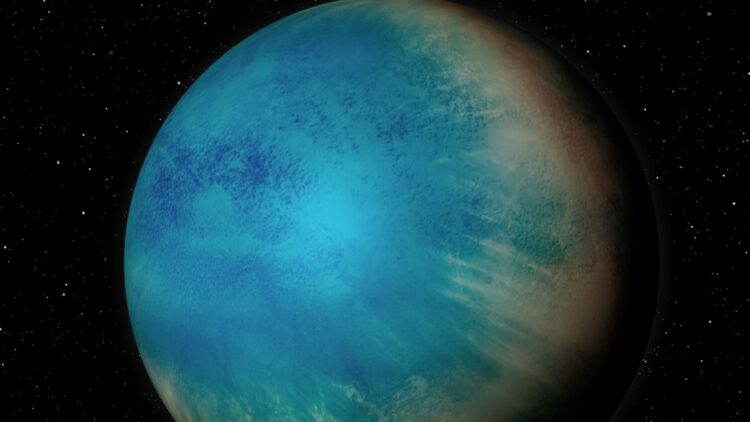
Only 100 light-years from Earth, there is a planet that is causing a lot of buzz. Astronomers have identified it as TOI-1452 b, and it is not just any exoplanet, everything suggests that it could be covered by 30% water. We would be talking about the first ocean planet documented by science… And you know what water means on a planet, right?
The first ocean planet, a world that not only draws attention because of the possibility of containing water, but also because in the place where it is located (orbiting a star), the theories we know about physics and chemistry would not allow the existence of liquid water!!
The unthinkable seems real: TOI-1452 b challenges everything we thought we knew about exoplanets! At 100 light-years from Earth, it could be our distant cousin.
The discovery
The key is in the combination of its low density, the temperature it receives from its star, and its size, they are the perfect mix.
The first analyses indicate that it could be made of layers of liquid water or ice, similar to the hidden oceans of the moons Ganymede and Enceladus. And as if that weren’t enough, its location in the constellation Draco makes it a perfect target for the James Webb Space Telescope, which is already preparing to analyse its atmosphere in search of signs of life (or at least habitable conditions).
TOI-1452 b: a super-Earth
Comparisons are unpleasant, but really this planet could be our sibling cousin (older, yes). TOI-1452 b has a diameter 70% larger than Earth and a mass about five times greater. These numbers classify it as a super-Earth, a type of rocky planet bigger than ours but smaller than gas giants.
When analysing its density, scientists noticed something that didn’t match up with worlds of rock and metal. Was it a bird? A plane? No! Water! Or at least, that’s what they believe because its mass is too light to be made of metals and rocks, so water is the most logical explanation researchers have found.
Too close to have water
What scientists still don’t quite believe is that this planet completes its orbit in just 11 Earth days, which means it is very close to its star to have liquid water. Stop, because we said TOI-1452 b is much bigger than our planet, but not the star it orbits, a red dwarf that is much smaller and cooler than our sun, so maybe that mix is what allows liquid water to exist on this planet. Isn’t it incredible?
James Webb, I choose you!
Of course, the star of this research will be, as always, the James Webb telescope, which is expected to analyse the atmosphere of the exoplanet when it passes in front of its star.
With this, it will be possible to identify the planet’s main gases (water vapor or hydrogen), but researchers even believe they could identify organic compounds if biosignatures are found. Are we witnessing the first step toward discovering life beyond Earth?
Why call it a “water world”?
Because, although it hasn’t yet been discovered whether it has water or not, we can say that TOI-1452 b is emerging as the planet with the most characteristics similar to Earth (and not only that, also the first one that science dares to confirm could have water).
Of course, the goal is to know how planetary systems are formed, but what about the possibility of life beyond Earth? It could perfectly sustain life in a similar way to what we have on Earth (although maybe they’re not as conflictive as us humans).
Without a doubt, what stands out most about this discovery is that, if a planet so close to its star can have large amounts of water, we may have underestimated the number of habitable worlds in our galaxy!