
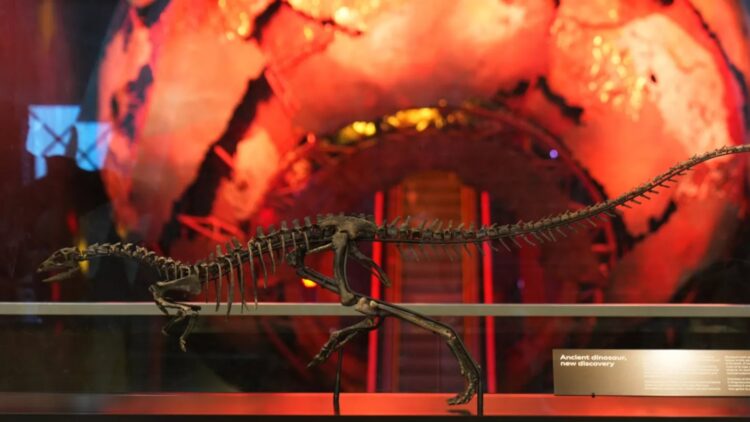
A dinosaur was recently found! We are used to other discoveries in the paleontologist field, objects or ruins, but dinosaurs? This time we are talking about Enigmacursor mollyborthwickae, the easy name dinosaur was found in the Colorado Morrison Formation and studied by two paleontologists, Paul Barrett and Susannah Maidment, from the Natural History Museum in London.
These types of findings are also very important because, in this case, this herbivorous dinosaur – related to the Chinese Yandusaurus – is crucial to know more about the diversity of species that coexisted during the Late Jurassic period. So, let’s find out more about this discovery!
A dinosaur whose size is similar to a dog
Everytime we think of dinosaurs, we tend to think of them as these huge creatures and the first dinosaurs that come to our minds are the T-Rex or the Brachiosaurus. However, this doesn’t apply to every dinosaur and this is the case of the Enigmacursor mollyborthwickae, the new species found. It lived around 150 million years ago, during the Late Jurassic period, but this is not the most remarkable aspect because this animal was the size of a labrador retriever! Can you imagine it?
The place of the discovery
The Enigmacursor mollyborthwickae’s skeleton was found in Colorado, in the United States at the Morrison Formation. This is a popular place known for its dinosaur fossils from the Age of Dinosaurs.
What was surprising was the fact that the Enigmacursor mollyborthwickae was found almost complete, the only thing missing was the skull. Why was this surprising? Because the normal thing about finding small fossils is to find them incomplete, more than this recent one. As it was very well preserved, it makes it very valuable for the scientific community since it’s rare to find small fossils in such good conditions.
More details about the Enigmacursor mollyborthwickae
This animal was herbivorous and had a light body, a tail like a counterbalance and long hind legs it used for walking or running. Its body was designed to reach high speed, probably to escape from bigger predators. Also, its tail is long for a reason, it helps this dinosaur to maintain its balance while moving so fast.
There’s not much information about the Enigmacursor mollyborthwickae, for example we don’t know how it died or what its skull looked like, but the data discovered is useful to know about its behavior and its role in the ecosystem of the time.
What about the name?
This dinosaur’s name is not that hard to remember: Enigmacursor mollyborthwickae. Who wouldn’t remember such a name? The truth is it has a logical meaning behind it because ‘’Enigmacursor’’ comes from Latin and it means ‘’mysterious runner’’, which makes so much sense having in mind what we mentioned about its body and the fact that we still don’t know things about it. Then, ‘’mollyborthwickae’’ is an homage to Molly Borthwick, the woman who donated the fossil to the Natural History Museum of London where it’s currently studied and displayed.
Importance of this discovery
This finding is very useful for scientists to better understand this species diversity from millions of years ago. Even though the biggest ones are the most popular for us, small dinosaurs are also an essential part of ancient ecosystems.
What’s more, the Enigmacursor mollyborthwickae is related to the Chinese Yandusaurus hongheensis, which translates into similar species existence in different places around the world.
Every dinosaur finding is very fascinating and the fact that we get to know how these species lived or their features is very important for paleontologists and the study of the Jurassic period. Thanks to museums like the Natural History Museum in London, we have the chance to be closer to these. Have you ever seen a dinosaur? At museums, of course!