
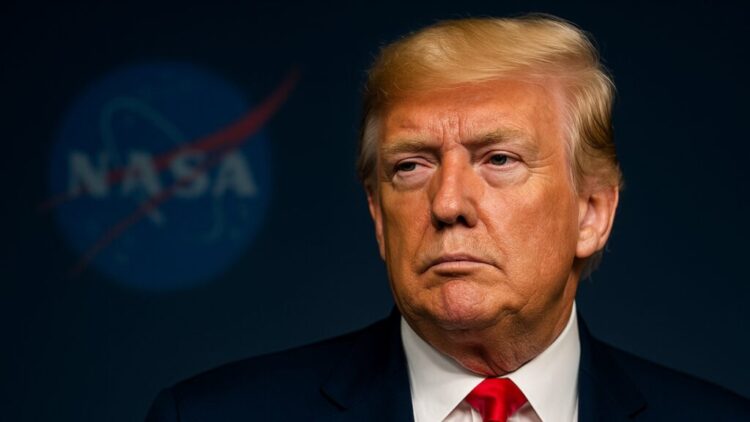
The Trump vs. NASA fight has finally ended with a winner. The United States Senate has approved a reconciliation bill in which the Trump administration will allocate billions of dollars to NASA’s Artemis program. Yes, at first, the Trump administration wanted to shut down several NASA programs, arguing they were not essential expenses. That put NASA at the bottom of the global space race, leaving its years of research behind for other countries that continue developing their own space projects.
A new lunar plan that contradicts all the criticism from Musk and his allies: $10 billion for Artemis, more SLS rockets, funding for the Gateway station, and a response to those who believed NASA was done.
A rupture with SpaceX
The tension between Trump and Musk has also affected SpaceX, which thought it would end up dominating outer space. This tension also played a role in the withdrawal of Isaacman’s nomination as NASA chief. The outlook is not just tense, but it could also change the course of American space exploration for decades.
A billion-dollar endorsement of a questioned model
The budget package approved by the Senate includes $4.1 billion to build more SLS rockets for Artemis 4 and 5 missions. Added to that are $2.6 billion for the lunar Gateway station and extra funding for other projects tied to Mars and the functionality of the International Space Station.
What is the SLS and why does Elon Musk criticize it?
The Space Launch System (SLS) is a non-reusable rocket that has been in development since 2011. It competes with SpaceX rockets, which are reusable. Elon Musk has called the SLS a “billion-dollar rocket that gets destroyed with every launch”, and according to recent data, the cost per unit could reach $2.5 billion.
Despite these figures, Congress has decided to keep betting on this technology, favoring traditional contractors like Boeing, Aerojet Rocketdyne, and Northrop Grumman.
Isaacman also expressed doubts
During his Senate confirmation hearing, Jared Isaacman (entrepreneur and astronaut, chosen by Musk, by the way, to lead NASA) also commented on the costs, confirming that for the next two missions it could work, but in the long run it would not be viable for repeated trips to the Moon or even to Mars.
However, his influence declined after the split between Musk and Trump, which ended his nomination as head of NASA.
Politics prevails over scientific vision
What is most surprising about this move is that it contradicts the White House’s own budget proposal, which in May suggested gradually ending the use of SLS and the Orion capsule after Artemis III. But now, with this new funding, that plan is reversed, reinforcing the more expensive and older model over alternatives like Starship, SpaceX’s flagship spacecraft.
The future of NASA
In addition to the lunar plan, the approved package includes $700 million for a telecommunications probe to Mars, $1.25 billion to continue operating the ISS, and $325 million for SpaceX, which will develop a spacecraft capable of deorbiting the station in 2030.
What consequences will this decision have?
This distribution could cause traditional contractors to slow down the transition to more affordable and reusable technologies…
But it also reflects a political and business battle over the future of space. It’s Congress versus Musk.
If Trump signs the bill, the gap between the old space guard and the new tech players will only grow wider.