
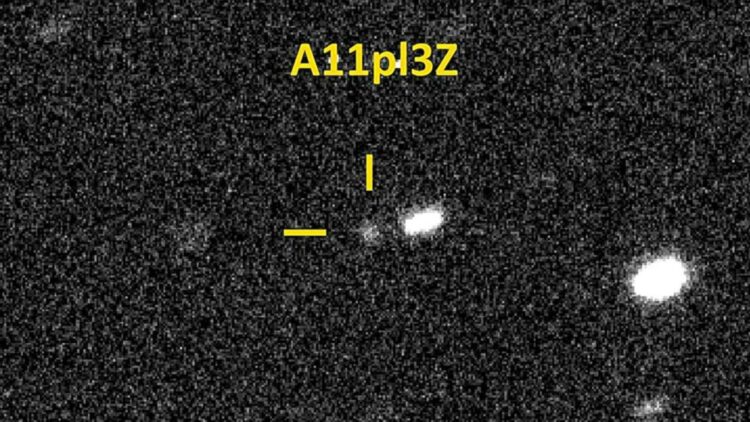
NASA has detected an object traveling at 245,000 km/h! A real fireball heading toward our solar system. It does not follow any gravitational law we know and strays from any usual behavior an asteroid might have. Of course, they’ve given it a name: A11pl3Z, and they believe it could be the third-largest object ever observed by humans from space. A comet. A very big one. Naturally, it raises a lot of questions… what happens now?
What is a comet?
To understand what is happening, we first need to understand what a comet is, right? They are a type of celestial body made of ice, dust, and rocks. They orbit the Sun and have very elongated ellipses. You’ve probably looked up at the sky and seen one before, it has a coma (an atmosphere) surrounding the comet’s nucleus that makes it look very bright, and a long tail of gas and dust that always points toward the Sun.
Of course, they’re not nearby. They’re usually found in the Kuiper Belt (beyond Neptune) or in the Oort Cloud. So… where does A11pl3Z come from?
What is the object A11pl3Z?
It’s fast, that much we know. It has surpassed the speed of other stellar objects observed by humans, like ʻOumuamua (2017) and 2I/Borisov (2019), and well, 245,000 kilometers per hour is not a speed reached by objects trapped by our Sun, so we could say A11pl3Z does not orbit, but moves in a straight line. Is it just passing by? Does it want to stay? Will it crash into something?
What does its behavior tell us?
It fits the profile of interstellar objects that briefly pass through our environment before returning to intergalactic space.
It was detected on June 25 by the ATLAS system, and it’s expected to pass very close to Mars in October, with its closest point to Earth in December, and don’t worry. It won’t impact Earth, we’re not the dinosaurs. By the time this object passes, Earth will be on the other side of the Sun, so, close? Not really.
Comet, asteroid, or something totally new?
Nobody knows! The object is between 10 and 20 kilometers wide, but it still does not show clear signs of cometary activity like others have. Some scientists believe it could be an extremely faint comet or a dark asteroid. Others, more daring, don’t rule out a still-unclassified nature, remembering what happened with ʻOumuamua, whose origin is still debated. Richard Moissl, ESA scientist, believes that although they are not 100% sure it’s a comet, any other explanation would be a surprise.
As expected, James Webb is already on it, and the Vera C. Rubin Observatory (in Chile) has been identified as a key player in tracking the object and gathering data over the coming months.
There are only two precedents… and they were very different
So far, the only confirmed interstellar objects were the ones mentioned earlier, ʻOumuamua (100–1,000m) and the comet 2I/Borisov. The first sparked controversy due to its elongated shape, its non-gravitational movement, and the lack of a coma… and because it was believed to be an object launched by a very distant civilization… Meanwhile, the second behaved like a conventional comet, but with a hyperbolic trajectory.
Both cases showed that the universe is full of unexpected visitors, and that many could be crossing our solar system without us noticing!
How many more could be out there? NASA explains
According to estimates by astronomer Mark Norris, there could be up to 10,000 interstellar objects crossing the solar system undetected. This could revolutionize our understanding of how our environment interacts with the rest of the galaxy. And if any of them carry organic compounds, they could even offer clues about the origins of life in the universe!
So no, A11pl3Z is not just a fast-moving object. It might contain information we could never imagine, it could suddenly change its orbit and become a threat. Who knows? It’s so unknown that it could reveal so many clues… And our astronomers will be there, investigating where this space Lightning McQueen came from. Our universe is so interesting and we know so little about it!