
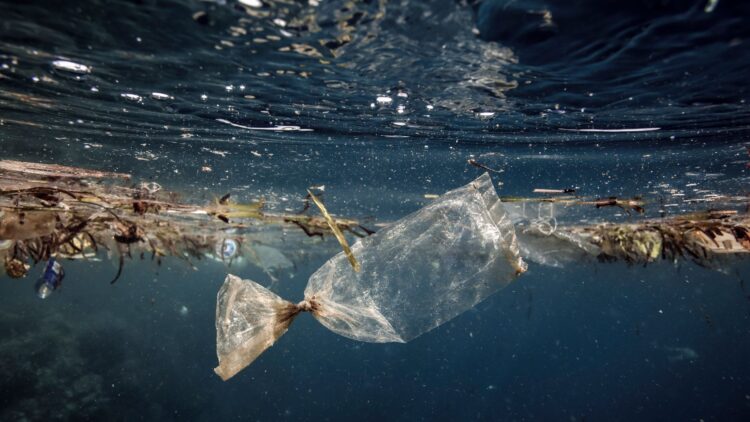
What do we really know about our oceans? There’s something we might not know and it’s worrying scientists a lot: nanoplastics in the North Atlantic Ocean. are even more widespread than the better-known microplastics and macroplastics. This finding is part of a study from Utrecht University and shows these nanoplastics are inceasing in number is very concerning way, more than we think. They found common plastics like PET, PS, and PVC, but some types like polyethylene and polypropylene might be there too — just harder to detect with current methods.
Experts such as Helge Niemann and Dušan Materić from the Helmholtz Centre for Environmental Research warn that this kind of plastic pollution could have serious effects on marine ecosystems — effects we still don’t fully understand. Let’s know more in detail about what’s happening in our oceans.
What’s going on in the Atlantic Ocean?
A new study from Utrecht University has uncovered a bigger issue than anyone realized: the North Atlantic is full of nanoplastics — teeny particles of plastic under one micrometer (yes, thinner than a human hair!). These tiny pieces might actually outnumber the bigger plastic bits floating around, and we’re not sure just how seriously they affect ocean life.
The researchers estimate there could be as much as 27 million tonnes of these nanoplastics in the North Atlantic—almost one-tenth of all the trash dumped by the U.S. in a year. That’s a massive amount, and it shows just how big the problem of plastic pollution really is.
Which types of plastics were found and where?
Scientists found several types of plastic commonly used in everyday products, including:
- PET (polyethylene terephthalate), used in plastic bottles.
- PS (polystyrene), found in disposable cups.
- PVC (polyvinyl chloride), used in wraps and plastic film.
However, some very common plastics did not appear in the samples, such as polyethylene and polypropylene. Researchers believe this may be due to two possible reasons: either the particles are masked by organic matter, or current techniques are not sensitive enough to detect those materials at such small sizes.
Nanoplastics were found at all the depths sampled—even near the coasts, due to river input and runoff—andin the subtropical gyre, a region of the ocean where circular currents trap plastic, which then breaks down into smaller fragments.
What effects do nanoplastics have?
Although the exact impact of nanoplastics on marine ecosystems and the species that depend on them (including humans) is not yet fully understood, scientists warn that these very small particles interact differently with water, sediments, andorganisms compared to larger plastics.
According to chemist Dušan Materić, from the Helmholtz Centre for Environmental Research in Germany, nanoplastics and nanoparticles are so small that the physical laws that govern larger particles no longer apply. That means their behavior in the marine environment is different, and potentially more harmful.
What the researchers plan to do next
The researchers say their next step is to take samples in other ocean regions and look for other types of plastics, including those that haven’t been detected by current techniques. They also consider it important to study the different stages of plastic degradation, depending on how long the particles have been in the water.
Prevention before regret
Eliminating nanoplastic pollution will be extremely hard, due to their size and distribution. Therefore, experts insist that the most important step is to stop plastics from entering the environment in the first place.
Until very recently, many scientists doubted that nanoplastics even existed in nature, because their formation requires energy conditions that seemed unlikely. But as Materić says: “Our findings show that, by mass, the amount of nanoplastic is comparable to what was previously found for macro and microplastic — at least in this ocean system.”
We should listen to scientists and go little by little, but we need to contribute in a positive way to this polluting situation the Earth is experiencing, therefore, us.