
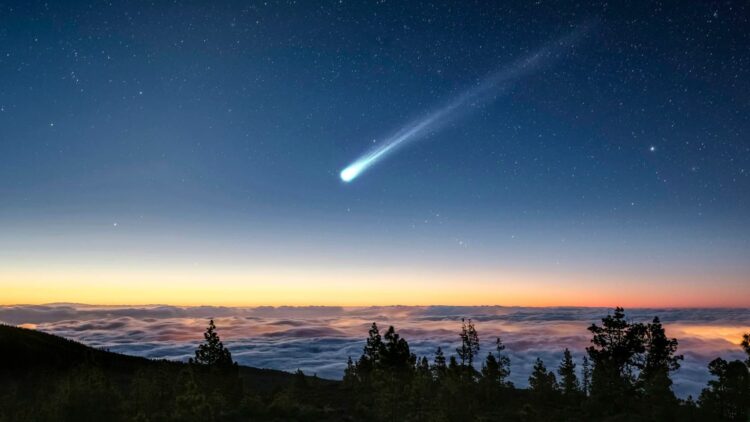
We know space is a mysterious place full of planets, stars, comets, and strange objects drifting silently through the darkness. But, now and then, scientists show us findings that bring us closer to this unknown place. What we know is that elements out there tend to glow and shine, but this wasn’t what happened with the latest scientific discovery. A group of astronomers, while studying the sky for unusual space activity, came across something they weren’t expecting at all: a comet so dim and quiet, it had almost escaped their view entirely.
This discovery could mean a new opportunity for scientists (and us) to know new things about how comets age and disappear. So let’s get started with this fascinating scientific finding!
How was this comet discovered?
This wasn’t a discovery made on purpose. A group of astronomers was searching for strange things in space and they found one: a comet that was very hard to see. It was so faint that it was almost impossible to tell it apart from the “noise” of space (those signals that look like background fuzz).
Also, its path in space was different from other objects, and it didn’t shine like comets usually do. That got their attention. So they decided to study it more closely using very sensitive equipment made by scientists on Earth.
Unusual aspect of this discovery
Once they focused a bit more on this finding, they saw that this comet was different in comparison to the others.What scientists are used to seeing is bright comets with a glowing tail that can be seen from thousands of kilometers away. But this one no longer glowed, it even looked almost dead.
Scientists believe the cosmic element has already used up all its ice and gas, which are the materials that make it shine when it gets close to the Sun. Without those materials, the comet no longer had that bright light. It only left a soft trail of dust and small loose pieces, like an old blanket falling apart.
What do these last moments mean for science?
What the scientists saw was something very special: the last moments of the comet’s life. This helps prove that all comets, over time, wear down until they disappear.
Comets travel around the Sun, and that constant motion slowly makes them lose their shape, their structure, and their materials. That final stage is called the terminal phase of the comet, and that’s exactly what they saw.
What happens now?
This discovery is very important. It makes scientists realize that they need better tools to find more objects like this one, which are hard to see. If something this interesting was so close and almost nobody noticed, it’s very possible that many other things are hiding in space waiting to be found.
This comet wasn’t just interesting by itself; it also opens the door to learning more about how comets get old, how they connect with the rest of the solar system, and even what they might have to do with asteroids and other space objects.
A fading light, but leaving clues
The cosmic element left behind a trail of faint light before disappearing, and it reminds us that the universe is so mysterious and still has many things to be found that we can’t see with our eyes. Fortunately, they will be found through science.
Each new discovery brings us closer to understanding space. And with each improvement in powerful telescopes and tools, scientists can see farther, deeper, and in more detail what’s going on out there. Who knows if the next space discovery will be even more surprising.