
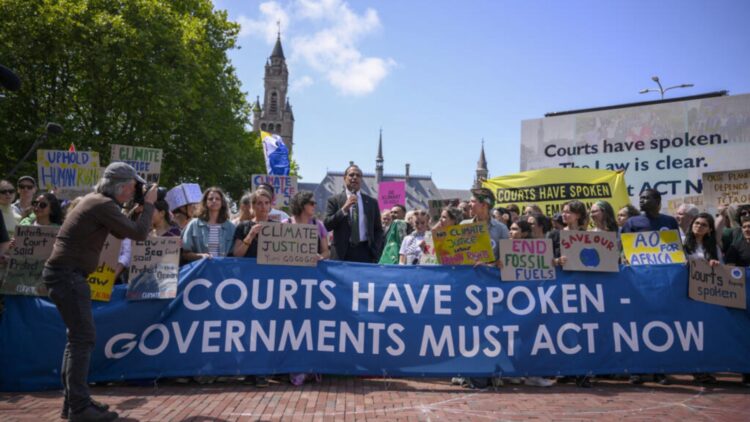
What if a global court told countries they have to fight climate change or face the consequences? There’s no ‘what if’, it’s actually happening. The United Nations’ top court has spoken, and the message is loud and clear: climate change is real, dangerous, and caused by humans. That’s why nations must act now or be held accountable. But… Can the court actually make countries listen? Let’s learn more about what’s happening.
What did the World Court say about climate change?
The UN World Court, also known as the International Court of Justice (ICJ), just said something very important about climate change. It said that the consequences of climate change are serious, affect many parts of the world, and represent an urgent threat to everyone.
It also said that countries must do something more than trying to stop or reduce that threat: take legal responsibility if their actions affect other countries. It seems fair, right?
What does that mean?
It means that if a country pollutes a lot and that causes harm to another country (for example, causing more storms or rising sea levels), that country could be considered legally responsible. The UN wanted to know exactly what laws already exist about this and what consequences there should be if they are broken, and that’s why it asked the ICJ for an official opinion.
Why did some countries ask for this opinion?
This didn’t come out of nowhere. Some small countries, like the Maldives and Vanuatu, have been asking for this for a long time. They don’t pollute much, but they are suffering a lot from climate change, like rising sea levels or stronger and stronger storms.
These countries are afraid of disappearing and want it to be recognized that it’s not fair that they suffer because of the actions of others. That’s why they asked the UN General Assembly to ask the World Court what the law says about this.
Who is causing climate change?
When this official opinion was presented in The Hague, the president of the court, judge Yuji Iwasawa, was very clear: greenhouse gas emissions are without a doubt caused by human activities.
This means that climate change is not something natural that happens on its own. We humans are the ones causing it, mainly by burning fossil fuels (oil, gas, coal, etc.).
The court relied heavily on a very important report published in 2023 by the Intergovernmental Panel on Climate Change (IPCC). That report said that between 3.3 and 3.6 billion people are highly exposed and at risk because of climate change.
Do countries have to obey what the Court said?
Well, this opinion from the court is called an Advisory Opinion, which means that it is not a mandatory order, but a legal guide. So, countries can decide whether to use it to make decisions, but they are not required to follow it.
The court can’t force countries to do what it says in this opinion, unless those countries agree to follow it. It’s like a strong legal recommendation, but it cannot be enforced by force.
What’s happening with technology?
All of this is happening right when tech companies are building huge data centers to run artificial intelligence. But those data centers need a lot of energy. Most likely, that energy will come from burning fossil fuels, which releases even more carbon dioxide (CO2) into the air.
That means that, even though we’re making progress in technology, we’re also creating more pollution, which makes the climate problem even worse, just when we should be fixing it. Do you think countries should follow what the UN suggests?