
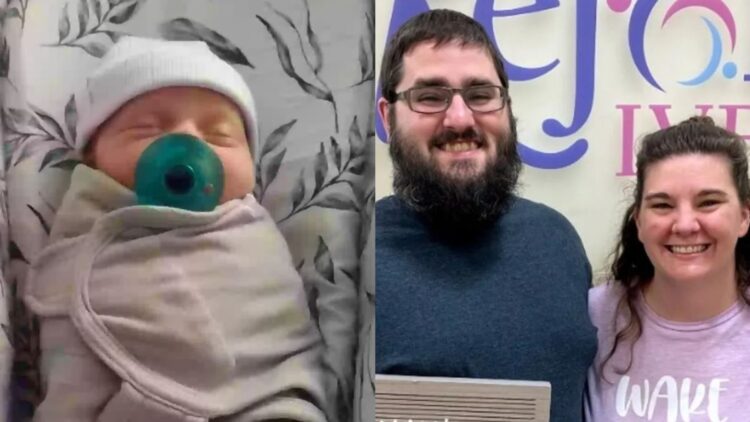
A baby born from the past? Imagine being born in 2025 from an embryo that was created before DVDs, smartphones, or Google even existed. That’s the remarkable story of Thaddeus Daniel Pierce—a baby who began his life in a lab dish in 1994, was frozen for more than 30 years, and finally entered the world in the arms of parents who weren’t even adults when he was conceived.
It is not just a medical milestone—it is a window into how science can reshape our understanding of time, family, and the beginnings of life itself. As fertility preservation advances and embryo storage becomes more common, the question isn’t just if it can be done—but why, how, and what it means for the future.
Technology pushes the limits of reproductive medicine, family, and time itself. So, let’s learn more about this baby.
How was this birth possible?
In the 1990s, a woman named Linda Archerd and her husband underwent in vitro fertilization (IVF) treatment. From that treatment, four embryos were created. One was implanted and became a daughter (who is now 30 years old and has a 10-year-old daughter).
The other three embryos were frozen and not used at that time. Years later, Linda separated from her husband and, after reaching menopause, decided what to do with those embryos.
What did the biological mother decide?
As a Christian, she did not want to donate them to science or to an anonymous couple. Instead, she chose what’s known as “embryo adoption,” a process in which she could choose the future adoptive parents, managed through a Christian agency.
Who ended up adopting the embryo?
The agency Nightlight Christian Adoptions connected Linda with a couple from Ohio: Lindsey and Tim Pierce. Linda was looking for a couple that met her requirements: a Christian, married, and Caucasian couple.
So, once she had the perfect couple, in November 2024, two of the three embryos were implanted in Lindsey’s uterus. One did not grow, and the other developed into baby Thaddeus, who was then born in July 2025.
How curious it is that the adoptive father Tim Pierce was a young child when the embryo was created, in 1994.
What did the biological mother say?
After seeing photos of the baby, Linda, who is now 62 years old, said that Thaddeus looks a lot like her daughter when she was a baby.
Is this a common thing?
This is not common, although there have been previous cases of babies born from embryos that were more than 27 or 30 years old.
Many clinics do not accept such old embryos due to concerns about how they were stored or whether they can still develop properly. However, some Christian doctors, such as John Gordon, promote the use of frozen embryos so they are not left unused. He founded a clinic called Rejoice Fertility Clinic for that purpose.
It is estimated that there are millions of frozen embryos in storage around the world, left over from fertility treatments that produced more embryos than could be implanted.
Limits are expanding
Thaddeus’s story makes us pause and think about where science is taking us—and what it means for real people. How long should frozen embryos be kept? Who gets to decide what happens to them? And what does it mean, emotionally and ethically, to start a life that was conceived decades ago? These aren’t just scientific questions—they’re deeply personal ones, too.
As reproductive technologies advance, so do the discussions around them. Whether you’re exploring fertility, considering adoption, or simply intrigued by science’s direction, stories like this remind us that the limits of possibility are constantly being redefined.
What do you think, would you consider embryo adoption and having a baby conceived when you were a child?