
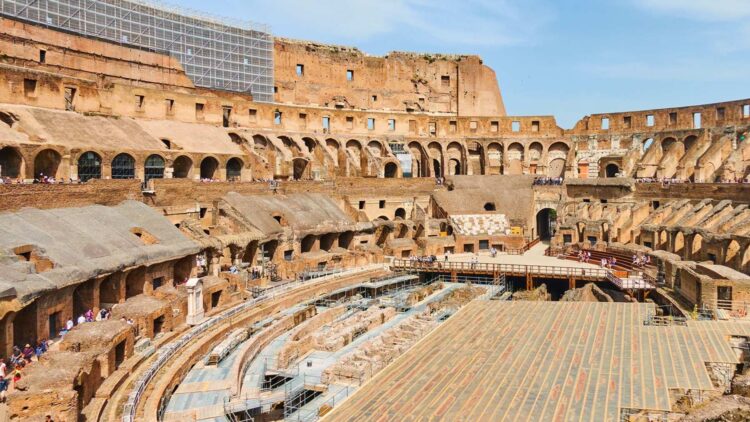
Can ancient concrete help build a greener future? We have seen modern architecture that helps the environment, but imagine walking along a Roman aqueduct or standing beside a 2,000-year-old harbor wall, knowing that the structure beneath your feet has survived storms, earthquakes, and centuries of saltwater erosion—without a single modern repair. That kind of longevity seems almost impossible today, when many concrete bridges, highways, and buildings start to crack and crumble after just a few decades.
With climate goals looming and modern concrete responsible for nearly 8% of global carbon emissions, the construction industry is under pressure to innovate. Researchers are turning to history for answers—and the durable, self-healing concrete of ancient Rome has caught their attention. So, let’s have a look at this Roman concrete and its possibilities.
What did they discover?
Somewhat surprisingly, researchers found that Roman concrete requires more water and emits more greenhouse gases during production compared to modern Portland cement (the most commonly used today). At first glance, it seems less efficient.
However, when the service life of the material is considered, the results change. Since Roman concrete lasts much longer without needing repairs or replacement, its environmental impact over time may be lower.
For example: In buildings, Roman concrete would have to last at least 41% longer than modern concrete to have the same overall environmental impact. For infrastructure like streets and highways, it would need to last 29% longer.
What makes Roman concrete special?
One key difference is that modern concrete is usually reinforced with steel, which provides strength but also makes it more vulnerable: steel rusts over time, expands, and causes the surrounding concrete to crack in just a few years.
By contrast, Roman concrete does not contain steel reinforcement and has a unique property: it can “self-heal.” When a crack appears and water enters, a chemical reaction occurs that naturally seals the gap. This has allowed many Roman structures, even in coastal areas, to resist the effects of time and saltwater exposure.
How was it made?
Both modern and Roman cement are based on quicklime, which is produced by heating limestone. When mixed with water, this quicklime becomes a highly reactive paste that acts as mortar. But there are important differences:
- The Romans mixed the mortar with locally available volcanic rocks.
- Today, gypsum and other industrial additives are used instead.
- Additionally, the Romans used oak or fir wood as fuel to heat the limestone, whereas today, fossil fuels are used, which generate more pollution.
According to recent models, using Roman methods could reduce nitrogen oxide and sulfur oxide emissions by up to 98% compared to current techniques.
Why is it important?
Concrete is the second most widely used material in the world, after water. But its production is highly polluting:
- It accounts for about 8% of global human-caused carbon emissions.
- It is responsible for nearly a quarter of industrial emissions.
- If cement production were a country, it would be the third-largest emitter of CO₂ in the world, behind only China and the United States.
Materials scientist Narayanan Neithalath, from Arizona State University, warns that to meet the 2°C global warming limit set by the Paris Agreement, cement-related emissions must fall by more than 20% in the next 10 years.
What does this mean for us?
The idea that ancient Roman concrete could help solve some of today’s environmental challenges might seem unlikely—but it’s a real possibility. We may be able to build stronger, longer-lasting structures while reducing pollution and carbon emissions if we combine historical techniques with modern science.
And that raises important questions for all of us: What should we value more—speed and cost, or durability and sustainability? As cities expand and the climate crisis grows more urgent, the materials we choose to build with matter more than ever.