
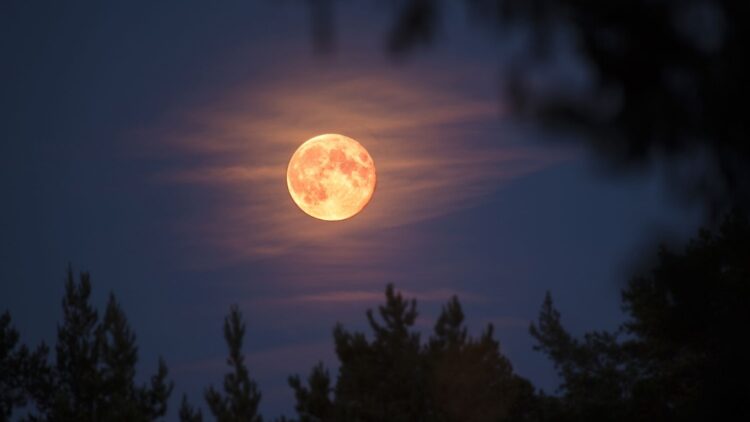
The major lunar event of August. There are many phenomena happening in the universe, but the Sturgeon Moon will be one of the most notable astronomical phenomena of the month of August. It refers to the full moon for that month, and it will reach its peak of total illumination in the early morning of Friday, August 9. However, the show will begin the night before, on Thursday, August 8, when it will already appear nearly full in the sky.
This phenomenon can be observed with the naked eye, without the need for telescopes or special equipment. According to the specialized website Time and Date, the moon will be fully illuminated at 3:55 a.m. (Eastern Daylight Time, EDT), but it will be visible from the previous sunset if weather conditions are favorable. In other words, if the sky is clear, anyone can enjoy the event from their home or from an outdoor space. So, let’s see more information about this event.
Why is it called the Sturgeon Moon?
The name “Sturgeon Moon” comes from the traditions of Indigenous peoples of the northeastern United States. During the month of August, these communities observed that it was the best time of year to catch sturgeon, a large fish found in the Great Lakes. That’s why they associated this full moon with the abundance of sturgeon during that season.
Over time, the name was adopted by other cultural groups, and today it is part of the traditional names assigned to each full moon of the year. In addition to “Sturgeon Moon,” in other regions and cultures it is also known as:
- “Grain Moon”, referring to the grain harvest season.
- “Corn Moon”, because it coincides with the corn harvesting period in many areas of the Northern Hemisphere.
Where will it be visible from?
It is visible throughout the Northern Hemisphere and you will be able to see it without using special equipment. However, you should have in mind to go to areas with low light pollution to better appreciate the Moon’s brightness and details.
In cities like New York, Miami, or Los Angeles, the Moon will appear on the horizon shortly after sunset on August 8, fully illuminated. For those living on the west coast of the United States or in Canada, it will also be clearly visible during the early hours of August 9.
Even if it’s not possible to see the exact peak illumination (at 3:55 a.m.), the Sturgeon Moon will remain bright for several consecutive nights, offering multiple opportunities to observe it.
Does it coincide with other events?
Yes. In addition to the Sturgeon Moon, the August sky will also bring other important astronomical phenomena:
On one hand, Saturn is expected to be visible in the night sky around the dates of the full moon.
Also, just a few days later, on August 12, the Perseid meteor shower will reach its peak—one of the most anticipated of the year due to its intensity and beauty.
This means that those who pay attention to the sky on those nights will be able to enjoy more than one astronomical event in a short period of time.
A moment to observe and connect
Beyond scientific or visual interest, the Sturgeon Moon is also a special moment for those who value connection with nature and ancestral traditions. The phases of the moon have marked the passage of time, agricultural cycles, and cultural celebrations for centuries in many parts of the world.
The Sturgeon Moon is an opportunity to pause, look up at the sky, and reflect, and also to share the moment with others, whether with family, friends, or at organized observation events in different cities.