
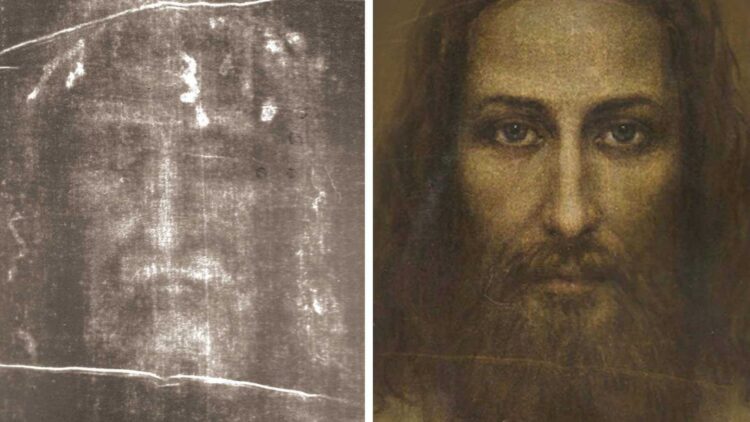
The Shroud of Turin: a miracle or a piece of art? Many believe that this fabric touched the body of Jesus after his death, and that his image was imprinted on it as if by magic. It has been one of the greatest mysteries in the religious world. But… what if someone told you it wasn’t a miracle, but a very clever creation made by artists hundreds of years ago?
Once again, technology is helping us solve another mystery, a new study using 3D technology has just revealed something surprising about this famous shroud. Want to know what they discovered? Keep reading!
What is the Shroud of Turin and what has now been discovered?
You’ve probably heard of the Shroud of Turin. It’s a very old and famous cloth because many people believe it was the shroud that covered the body of Jesus after his death. On the cloth, you can see the image of a man, as if his body had been imprinted on it.
For centuries, people have debated whether that image appeared by a miracle or was made by humans. Well, now, a new study using 3D technology says it was not caused by a real body, but may have been created in the Middle Ages as a religious artwork.
Who did this new study?
A Brazilian designer named Cicero Moraes, an expert in 3D historical reconstructions, led the research. He used a computer to create two 3D digital models: one of a real human body and another of a flat sculpture shaped like a person (like the ones used in ancient tombs).
Then, with simulation software, he placed a virtual cloth over each model to see how the shape would be imprinted.
The result? The image on the shroud matches much more closely with the shape of the flat model, not the real body. That means the image could not have been made by a human body, but was likely pressed onto a sculpture.
But isn’t the shroud really old?
Yes, it’s old, but not as old as was once believed. Back in 1989, a carbon-14 study (a method for dating very old objects) concluded that the cloth was made between the years 1260 and 1390, which means it comes from the Middle Ages, more than a thousand years after Jesus.
Also, at that time it was common for churches to create religious objects to attract believers and help them feel closer to God.
Why is the image so realistic?
That’s a great question—and one that scientists have also asked. In the Middle Ages, there were no cameras or printers, but artists were very inventive. This study suggests that someone may have created a flat figure (like a mold) and then placed a cloth on top, using heat or pigments (like powdered paint) so the image would transfer onto the fabric. That would explain why there are no visible brushstrokes or obvious paint stains, but the image still appears.
Is this the only study?
No. Other scientists have said similar things before. For example:
- In 1983, a researcher named Joe Nickell did similar experiments and said the image was made using a mold.
- In 2018, a study analyzed the bloodstains on the shroud and concluded that they didn’t follow the normal behavior of blood on a real human body. In other words, the stains didn’t match what would happen during an actual crucifixion.
- In 2009, an Italian professor named Luigi Garlaschelli managed to create a copy of the Shroud of Turin using only materials and techniques that existed in the Middle Ages.
All of these studies point to the same idea: the shroud did not touch a real human body, but was likely created as a religious image.
So was it all fake?
Not necessarily. This new analysis doesn’t say that the shroud has no value, but rather that its origin was not miraculous, but artistic. In fact, the researchers describe it as a masterpiece from the Middle Ages, made with great care and strong religious intention.
At that time, many churches used relics (sacred objects) to attract believers. Creating a shroud that appeared to have covered Jesus’ body would have had a great impact on people of faith.
Why is this discovery important?
Because it helps us understand how art, faith, and science were connected in the Middle Ages. It also shows how modern technology, like 3D modeling and computer simulations, can help solve ancient mysteries.
Even though some people still believe the Shroud of Turin is a miracle, this study shows that it could also be the result of human creativity.