
NASA has made history again! You’ve probably heard of the Parker probe, the closest ever to the Sun in all the history of space exploration. Well, it has managed to capture never-before-seen images of the solar corona. Incredible, another historic moment we’re living in this lifetime!
We’re getting closer and closer to the engine of our solar system, and this could completely change the way we predict solar storms (yes, they affect us even if they’re far away). So, we’re going to tell you everything NASA is doing! Here we go!
What is the Parker Solar Probe?
It is very small probe (the size of a car) that was launched in 2018. The goal? Going through the Sun’s outer atmosphere and getting data. Let’s be honest, people didn’t have much faith in it because the Sun could destroy everything, you know. But it has surprised us. Parker did its job… and what a job! It captured formations no human had ever seen before! And it did it during solar activity, when violent phenomena are at their peak, incredible!
A five-year journey
As we were saying, Parker’s mission went into the Sun’s atmosphere (the corona). And to gather all possible information about the atmospheric processes happening there. It wasn’t until 2021 that the spacecraft crossed that invisible boundary for the first time.
Now, in its latest approach, it got as close as just 3.8 million miles from the Sun’s surface. That distance might sound big, but on an astronomical scale it’s basically touching the Sun with your fingers!
The corona, the solar wind and magnetic storms
Thanks to the Wide-Field Imager for Parker Solar Probe (WISPR), the probe has photographed the solar corona, the solar wind, and a spiral structure known as the heliospheric current sheet. The images reveal a wild, chaotic and beautiful environment: a landscape of plasma and magnetic fields in constant change. So incredible…
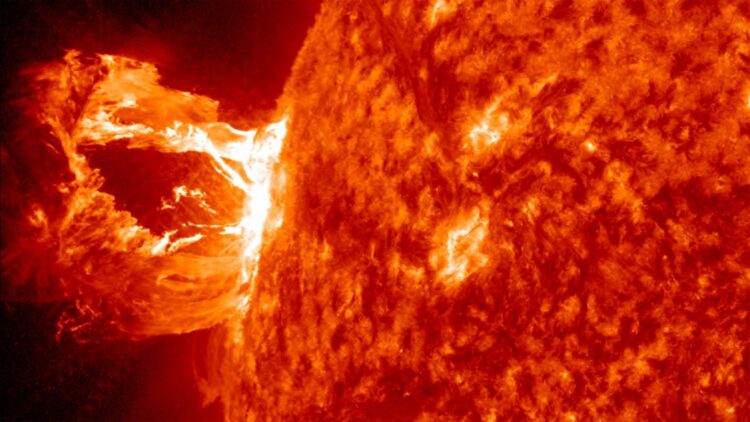
Among the most shocking discoveries are records of coronal mass ejections (CMEs), which are explosions of particles and magma launched at millions of kilometers per hour through space (like eruptions but solar). And yes, they’re a big threat to our technology because they can disable satellites or interfere with global communications.
Collisions in space
The most interesting thing, no doubt, that the probe captured is that it observed how several coronal mass ejections merged with each other, forming a single, much more powerful structure. According to astrophysicist Angelos Vourlidas, this phenomenon is extremely rare and could help better understand how space weather behaves.
Being able to predict a storm like this hours or days in advance could be the difference between a safe operation or a global blackout! (Can you imagine? It would be the closest thing to the Purge we ever live through)
Future space missions
Of course, NASA is already studying the results of this research to protect its future missions to the Moon and Mars. Especially now that Musk and Bezos want to boost commercial space travel.
What’s next for the Parker probe?
The Parker probe’s mission is not over. In the next few months, the spacecraft will get even closer to the Sun, facing extreme temperatures and intense magnetic fields. Will it make it? Every new pass offers an opportunity to better understand our star and anticipate the dangers it might represent for our planet.
As more images and data are released, the scientific community hopes to decipher hidden patterns, magnetic cycles, and solar plasma dynamics that until now were only theory.
What the Parker probe has achieved marks the start of a new era in humanity’s relationship with the Sun! We’re not just observing its surface anymore: now we’re studying it from inside its atmosphere, and it’s fascinating!
The exploration continues, but we can already say it: NASA has almost touched the Sun. And what it has seen will forever change the way we look at it.