
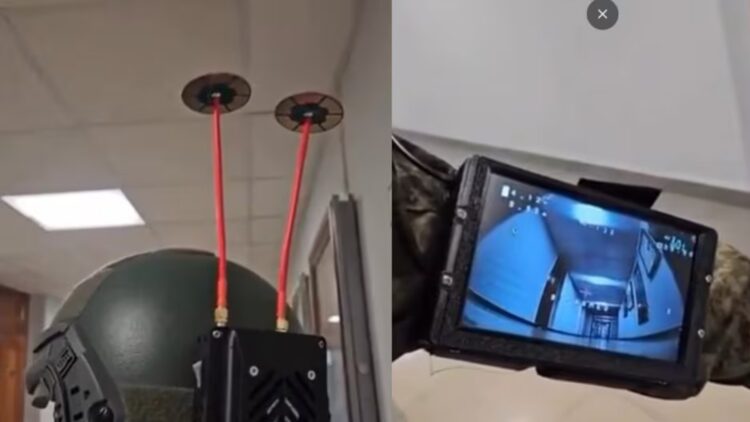
Wars are becoming more and more technological, and now, in the middle of the tug of war, Russia has pulled a move out of its sleeve that caught Ukraine by surprise. The novelty? A helmet with antennas that includes a portable electronic warfare system. And yes, it looks like Atom Ant, but it’s not just a helmet: it’s a kind of walking jammer capable of intercepting the video signal of enemy drones and leaving the opposing operator without vision from the sky. It’s not perfect, but it changes the picture quite a bit.
How does this invention work?
You might be thinking it’s a ridiculous invention, but in the videos that have come out from Russian military sources, you can see the complete equipment: helmet with antennas, small screen on the forearm, portable battery and several connections that make everything work as a closed system. But what does it actually do? The soldier detects the drone’s video signal (the one going to the enemy operator), intercepts it and can watch it himself on the device. And not only that. He can launch an interference that cuts the image, leaving the operator completely blind.
They don’t touch the drone’s control or its GPS navigation. Only the video. Why? Because that way they avoid the drone going into automatic mode, returning to base or doing strange things. The drone is still there, but the one piloting it can’t see anything anymore. Simple, but very effective.
Portability = immediate advantage
This equipment goes with the soldier wherever it’s needed, which allows the creation of individual protection bubbles. Imagine how useful that is in a city, or in the middle of a forest, where drones are constantly on the lookout. Also, since they only interfere with part of the signal (the video), the device needs less power and emits less signal, which makes it harder for the enemy to locate.
And the weak points?
Even if it’s an advance, this system is not useful for everything. For example, if the drone transmits the video by cable or with fiber optics, forget it. There’s no radiofrequency to intercept there, so the helmet does nothing.
And of course, Ukraine is not going to sit back. The most logical thing is that they start adapting their drones to use encrypted or harder-to-intercept channels. This is a technological race, and every step forward is usually followed by another to counter it!
Can this change the course of the war?
One of the biggest obstacles lately for any ground advance has been the drones, especially the FPV ones that go straight after individual targets. If this system manages, even for a while, to leave them without vision, Russian troops could regain some margin to move without being hunted instantly. And that, in a war as exhausting as this one, can make the difference.
From the base to the helmet
What’s clear is that this invention shows where things are going: electronic warfare no longer depends on trucks full of antennas. Now each soldier can carry their own technological defense gear. If Russia manages to mass-produce them and distribute them widely, the change will not only be tactical but also doctrinal.
And now what?
The war in Ukraine has become a real-time showcase of new military technologies, and this helmet with antennas is the latest example. It won’t win the war on its own, but it could make a real difference in certain areas and moments. And as always, in a conflict where every meter costs lives, any small advantage becomes another weapon. This time, the advantage might be right above each Russian soldier’s eyes.