
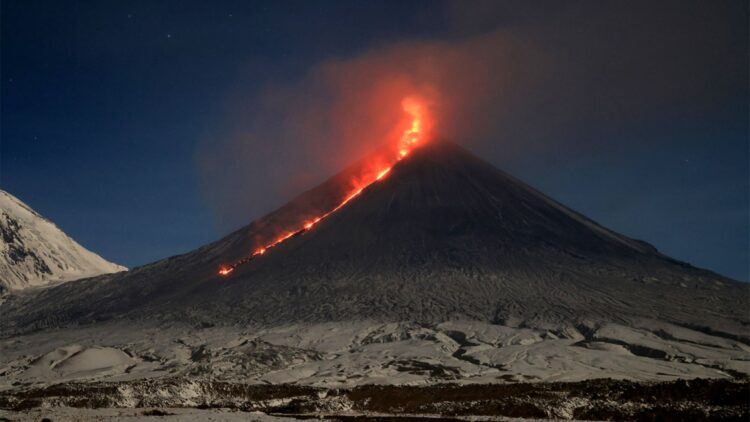
A volcano awakens after 600 years in Kamchatka. Imagine a mountain that hasn’t made a sound in more than six centuries suddenly roaring back to life. That’s exactly what happened last week in the far east of Russia, on the rugged and remote Kamchatka Peninsula. The Krasheninnikov volcano, quiet since the year 1463, has erupted.
The eruption started with an 8.8-magnitude earthquake in one of the most active seismic regions on Earth. It shook the ground hard enough to trigger tsunami alarms across the Pacific. Within hours, scientists began to wonder if the tremors could wake one of Kamchatka’s long-dormant volcanoes.
At 6:00 a.m. on August 3, those questions were answered. Staff at the Kronotsky Nature Reserve, where Krasheninnikov is located, saw ash rising into the morning sky. It was the first recorded eruption since scientific monitoring began in the area. So, let’s find out more about it.
Another Quake Follows
Days later, the ground shook again. This time it was a 6.8-magnitude earthquake, its center about 26 kilometers beneath the surface. Even though tsunami warnings were issued, in the end only small waves were expected along the coast.
Meanwhile, Krasheninnikov kept going. Thick plumes of smoke and ash drifted up from its slopes. If you were standing nearby (and no one was—thankfully), you’d see that this volcano is actually two cones fused together, stretching about nine kilometers from one side to the other. The sight of it sending fresh ash into the air after so many centuries must have been both eerie and awe-inspiring.
Not Alone in Its Awakening
Krasheninnikov wasn’t the only volcano to respond to the last massive quake. Then, Kliuchevskoi, the tallest volcano in Siberia, erupted soon after. Both sit within Kamchatka’s eastern volcanic belt, a hotspot for earthquakes and eruptions thanks to the movement of tectonic plates beneath the region.
Krasheninnikov is about 200 kilometers from Petropavlovsk-Kamchatsky, the peninsula’s largest city. In the 24 hours following the quake, at least 65 tremors were recorded in the region, according to Russia’s Interfax news agency. Only 10 were strong enough for people to feel, but the numbers tell you just how active this corner of the world really is.
A Rare Chance for Science
For volcanologists, this is the kind of moment you wait your whole career for. Krasheninnikov’s last eruption happened so long ago that there are no modern records of how it behaves. Now, for the first time in centuries, researchers can study it up close—tracking its ash, gas, and seismic signals.
They’ll be asking big questions: How exactly did the earthquake trigger the eruption? Could the same thing happen with other long-dormant volcanoes? What can this tell us about the deep forces that shape Kamchatka’s landscape?
The volcano’s unusual structure makes it even more intriguing. Two volcanic cones joined together in one massive form, sitting in one of the most active volcanic zones on the planet—it’s like nature built a perfect case study for understanding how earthquakes and eruptions interact.
Something to Think About
It’s tempting to think of mountains as eternal, unmoving things. But Krasheninnikov has just shown us how quickly that illusion can break. Six hundred years of silence ended in one sudden burst of energy. It makes you wonder—how many other volcanoes are quietly waiting for their turn?
The truth is, the Earth is constantly moving. Most of the time, we can’t see it. But every now and then, something like this happens, and we’re reminded that we live on a restless, living planet—and that we’re all connected to its story, whether we’re standing in Kamchatka or on the other side of the world.