
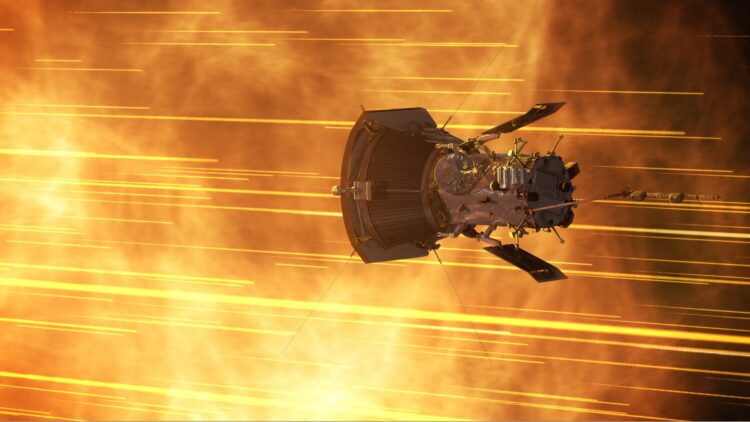
For decades, there was a question that not even the brightest physicists could answer: why is the outermost part of the Sun (the corona) much hotter than its surface? No one had a clear explanation. Until now.
NASA’s Parker probe has just confirmed something that until recently was only a theoretical suspicion: the existence of a helicity barrier, a kind of microscopic barrier that completely changes the way we understand the behavior of solar plasma. And with it, we also begin to understand why the solar wind behaves the way it does.
It is a huge breakthrough. And yes, for the first time, we have direct evidence.
What is this helicity barrier about?
What scientists have discovered is that near the Sun there is an invisible boundary that prevents the turbulent energy of the plasma from dissipating like in other parts of the universe. Under normal conditions, that energy mixes, spreads, and dissolves. But not here. Here, when plasma waves move in opposite directions, this barrier prevents them from mixing.
And when does that barrier appear? When the magnetic field is very strong compared to the plasma pressure. Exactly the kind of environment that exists in the solar corona. That is, exactly where Parker is collecting data.
An explanation for something that didn’t make sense
For years, they asked themselves why the protons in the solar wind were much hotter than the electrons. It didn’t make sense. The models didn’t explain it.
But with this barrier in the middle, they do. The energy is distributed unevenly, and the protons end up getting most of the heat. It’s not that the Sun is doing it wrong. It’s that it does it differently. Now we know.
This phenomenon, because it’s strange, only happens there
It’s not something you see in just any corner of the universe. For this barrier to form, you need very hot plasma, low density, and an intense magnetic field. And yes, that is exactly what exists in the solar atmosphere. That’s why it’s so important: it’s not just that we now understand the Sun, we have a real model to study other extreme zones of the cosmos.
This isn’t just about science
The fact that the Sun is releasing charged particles at full speed isn’t just a curiosity for physicists. That’s called solar wind, and when it gets out of control, it can affect satellites, power grids, communications, and navigation systems.
With this discovery, space weather prediction models become more accurate, and that is something that matters more and more to us in an ultra-connected world.
The Sun, as a natural laboratory
What Parker has just detected had never been seen outside of a computer simulation. This kind of plasma, hot and collisionless, isn’t exclusive to the Sun, but studying it up close wasn’t possible until now.
And that opens the door to better understanding things as distant as nebulae, black hole accretion disks, or any other place where energy behaves in a strange way.
Parker probe didn’t go there for sightseeing
The Parker Solar Probe is the reason we can talk about this today. It is the first spacecraft built by humans to get so close to the Sun. Thanks to that, it has managed to collect data that from Earth or from distant orbits are simply impossible to obtain.
This finding, already published in Physical Review X, is just one of the many expected from this mission. And seeing what it has already found, things look promising.
And now what?
Now it’s time to keep analyzing everything Parker is collecting. To see how this barrier evolves as it moves away from the Sun, to check if it appears in other environments in the universe, and to keep pulling the thread to understand how energy dissipates under extreme conditions.
This could be one of those discoveries that force us to rewrite textbooks. For now, what was just a theory already has a shape, evidence, and a name: helicity barrier.
And the best part: this is just getting