
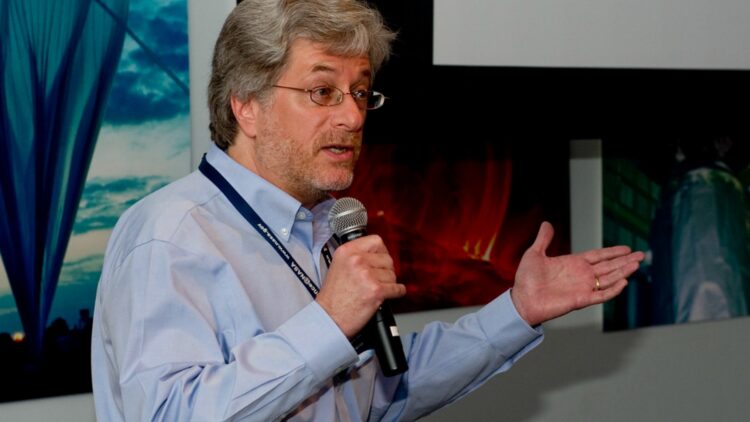
Steve Platnick says goodbye after 34 years looking at the sky. It is not that the man did nothing, nothing like that! He has not been fired, it is simply the moment for this man whose name may not sound familiar to you to say goodbye. After more than three decades at NASA, Steve Platnick retires!!! And well deserved! We are not talking about just anyone, this man has been a key piece in the study of climate from space, someone who dedicated his career to understanding what happens in the atmosphere, how clouds work and how all that directly affects the planet we live on.
His departure marks the end of an important stage for NASA, and leaves behind work that will continue to bring results for many years. Do you want to know more about Platnick?
Key missions
One of Platnick’s great milestones was his participation in the development of the MODIS sensor (Moderate Resolution Imaging Spectroradiometer). It may not sound as mediatic as the Hubble Telescope, but MODIS is a fundamental tool to observe what happens on Earth: it measures cloud cover, detects aerosols, analyzes the oceans… Key data to make weather forecasts and to understand how climate evolves.
And not only that. Platnick also worked on the development of algorithms that, to this day, satellites all over the world still use. In other words, his work did not remain only in theory, but became real tools that help us know, with concrete data, what is happening with our planet, and that is incredible.
More than 30 years observing clouds
Platnick was not one of those who just stare at the sky (well, maybe a little;)). His work has been key to understand how clouds behave, what role they play in the Earth’s energy balance and how climate change is happening.
Thanks to his work, today’s climate models are much more reliable. And now that the world is heating up faster and faster due to the greenhouse effect it is very important. During his career, he worked at NASA’s Goddard Space Flight Center, leading Earth observation projects that still set the course of climate research at a global level.
Inside NASA (and outside it) he is considered a benchmark. And no wonder, he has truly earned it.
A benchmark also for those who come after
For this man not everything was research, he was also a teacher. He dedicated himself to training new generations of scientists, sharing his experience and guiding those who are going to continue his work. Those who knew him highlight his way of teaching: close, demanding and always with his feet on the ground… even though his gaze was set on the skies!
His work has been cited again and again in studies all over the world, and he has participated in top-level conferences and publications.
And now what?
Although Steve is no longer at the forefront, his work does not go away with him. Everything he developed is still active and will continue to be for a long time. Missions like MODIS are still functioning and generating vital information. And what he left written or programmed continues to be a guide for current teams.
Obviously, NASA does not stop because someone retires. Platnick’s departure opens the door to new ideas, new faces and new ways of facing climate challenges from space. But filling his place will not be easy. His experience and his way of understanding science left a mark, no one can deny that.
Steve Platnick does not leave as just another. He leaves as someone who changed the way we look at the planet from the sky. His retirement is not only the end of a brilliant career. It is also the perfect moment to remember how important science is when it is done with commitment, with sense… and with the gaze well set on the clouds! Happy retirement, Platnick!