
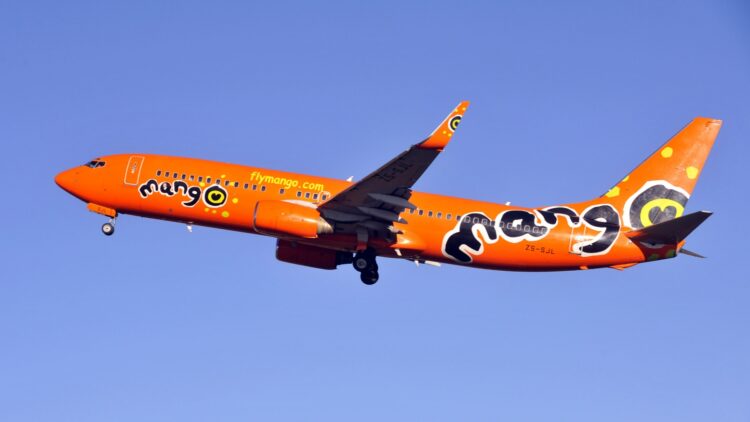
After years of back and forth, the story of Mango Airlines, the South African low-cost airline, reaches its final point. The plan to save it collapsed, the buyer backed out, and there is no way for the airline to ever take off again. Mango, which was born as the cheap option of South African Airways, could not handle the debts, the legal troubles, or the bureaucracy. It is over, no more flights…
The judicial administrator, Sipho Sono, believes that the best thing now is to close without making too much noise. This way, at least, creditors could recover a little more money than if everything is liquidated outright. But the message is the same for everyone: Mango no longer has a future in the air, nor on the ground.
The plan that never took off
In June 2025, a Johannesburg court struck down the plan that intended to resurrect the company. Even the majority of creditors voted in favour, there was one key player, Aviation Co-ordination Services (ACS), that said no. Their reason was that with the agreement they were only going to recover 4.43 cents for every rand they were owed, and on top of that they had to forgive part of the debt without receiving anything in return.
Judge Denise Fisher agreed with them, she stated that this plan was like a disguised expropriation, and she threw it out. Ubuntu Air Services, which was the company interested in taking over Mango, got tired of waiting and left.
And now what do the creditors do?
At this point, the options they have on the table are two: either accept the orderly closure, or go straight to liquidation. According to Sono’s own calculations, closing smartly would allow recovery of about 12.18 cents per rand. If everything is liquidated quickly, it would barely be 2.68 cents.
Either way, the result is the same: Mango Airlines will no longer offer flights. The hope that it would return after the fall of Kulula, to bring prices down again, has vanished.
What was left of Mango… was little
Even though on paper it still existed, Mango no longer had planes, staff, routes, or even licenses. Aviation expert Linden Birns said it clearly: only the name was left. And little more.
Even if Ubuntu had bought the brand, the plan was to use it only for charter flights within Africa Stay. In other words, nothing that would impact the domestic flights it used to offer.
Impossible red numbers
The money did not help either. Mango had a little more than 382 million rands in cash, but it owed nearly 3,000 million. And that included customers who still had tickets bought.
Between the debt, the lack of staff and planes, and a nonexistent infrastructure, it was unfeasible to reactivate the company. Not even with private investment.
An ending that could be seen coming
For years, Sono argued that Mango could move forward if the promised investment arrived. But the delays from the Ministry of Public Enterprises and South African Airways in releasing the money ended up choking the airline.
And with the exit of Ubuntu Air Services, it is over. South Africa thus loses one of its most accessible airlines. A symbol for many people who were able to fly inside the country without spending a fortune. Now, with less competition, what remains are fewer options and rising prices. Exactly what passengers have been fearing for a long time.